Our News, Your News
By David Haysom, October 1, '18

We are delighted to announce a new series from Read Paper Republic: China Dispatches. Over the next month we will be publishing a selection of non-fiction pieces chosen from OWMagazine (单读). This will be a three-way collaboration between Paper Republic, OWMagazine, and the LARB China Channel. Each of the stories will be appearing first on the China Channel, then published here on Paper Republic one week later. We’re very excited about our initial run, which includes some of our favourite writers as well as some new voices, and we’re sure you’re going to enjoy these dispatches from different corners of China.
The first installment – “Three Sketches of Peter Hessler” by Wu Qi, translated by Luisetta Mudie – is available to read on the China Channel now!
"No one, wise Kublai,” says Marco Polo in Italo Calvino’s Invisible Cities, “knows better than you that the city must never be confused with the words that describe it.” In Atlas: The Archaeology of an Imaginary City, Hong Kong’s Dung Kai-cheung writes, “All places are misplaces, and all misplaces are misreadings,” and “The prerequisite for the setting of boundaries on maps is possession of the power to create fiction.”
Welcome to a true life inspired account of passions set largely in the luxurious and exclusive confines behind the embassy’s steel gate in Beijing’s Sanlitun district. This is not merely the stark diary of the carnality and spirit of a blacklisted female writer in China. It also delves into the minds of the over-sexed, conflicted European men who populate the booming 21st-century capital, and the dark side of their relations with Chinese women who flock to them like moths to a white-hot light bulb.
From Leys' The Chairman’s New Clothes: Mao and the Cultural Revolution:
The author of this work…was impelled—by the weight of evidence thrown up in the texts, facts and personal accounts which assailed him daily in Hong Kong throughout the years of the “Cultural Revolution”—to cry out, like the child in the fairy story, “But the Emperor has no clothes!”
For commercial rather than political reasons, Mr. Zhou’s literary agent here also made changes in the English-language version of the book, translated by Zac Haluza. The action now takes place in Chengdu, the capital of Sichuan Province, not Yangzhou or nearby Nanjing, the cities Mr. Zhou said he had in the back of his mind when crafting the story. The assumption was that Chengdu, which is best known for pandas and spicy food, would be recognizable to foreign readers and give the drama a more visceral feel, Rob Bloom, Mr. Zhou’s editor at Doubleday, said in an email.
周浩暉的美國文學代理人出於商業原因,而非政治原因,也對該書的英文版做了些改動,英文版由扎克·哈盧扎(Zac Haluza)翻譯。英文版的故事發生在四川省會成都,而不是揚州或鄰近的南京。周浩暉表示,他在構思這個故事時,頭腦中一直想的是這兩座城市。周浩暉在雙日出版社的編輯羅布·布魯姆(Rob Bloom)在接受電子郵件採訪時表示,這是出於這樣的考慮:以熊貓和辛辣食物聞名的成都為外國讀者所熟知,更可能會讓讀者產生身臨其境的感覺。
“This child was a nobleman in a former life. Nobles may come calling, but they do not linger. In this child’s fate, there is death by water, by metal, by earth, and by wood. There is no death by fire.”
By Nicky Harman, May 13, '18
here
Lee and Rob got the chance recently to sit down with Dylan King, a scholar and translator of Chinese literature. In this podcast the three talk about the eccentricities and fascinations of post-Cultural Revolution fiction, and dive into Dylan’s recently-published English translation of Record of Regret, Dong Xi’s beautiful, and darkly humorous, account of a countryside family during and after the Cultural Revolution.
The subjects of “Dead Souls” were condemned in the Communist Party’s “anti-rightist” campaign in the 1950s. Like Ms. He, they were imprisoned, enslaved and starved in “re-education” camps like Jiabiangou in the Gobi Desert.
Article is bilingual (Chinese and English).
Few avid Chinese readers of fiction can name an African author or novel, and those who do often cite “Things Fall Apart,” the highly acclaimed novel by the Nigerian writer Chinua Achebe that portrays the tragic encounter between the Igbo tribe and British colonialism. It was first published in Chinese in the 1960s and has been reprinted countless times since. While literary circles in Africa no longer worship at Achebe’s altar, China’s literary establishment continues to trumpet him as the reigning “father of African literature,” almost to the exclusion of emerging authors.
One-stop, multi-media, whirlwind history of rap in China, complete with 10 catchy videos, and bilingual lyrics -- with insights into how the Party is busy co-opting this art form.
Anna Holmwood to speak at Storydrive (故事驱动)
(Beijing Jun 1, 2018 in Chinese & English)
为什么我翻译了《射雕英雄传》
Why I Translated Legends of the Condor Heroes
Away from the reach of the state, at least in his adult life, Tharlo’s seemingly only link with material modernity is his motorbike and his radio. But a new rule has decreed that all citizens of the People’s Republic of China must possess an identity card, including those living in such remote territories as Amdo (north-eastern Tibet, current Qinghai province).
The state’s edict finally reaches Tharlo, and the film follows him over a period of a few days, caught between two worlds: his familiar, rural, austere environment, where he takes care of three hundred sheep, and an nearby emerging half-Tibetan, half-Chinese town, where he has to go to complete the administrative formality.
Chinese writer Liu Zhenyun has been honoured with France's Knight of the Order of Arts and Letters for his contribution to world literature.
Anyone who reads Little Reunions will understand the origins of the stifling, hypocritical families of her fiction. Julie’s mother is a distant, pathetic stranger who treats her more like a casual acquaintance than a daughter, and her father is perpetually obscured by a haze of opium smoke. She refers to them as Second Aunt and Second Uncle—their place in the baroque family hierarchy. The endless network of cousins and concubines is less a loving family than a complicated business concern filled with unpaid accounts and threatened lawsuits. Semi-incestuous passions smolder for decades, and other secrets fester and rot.
By Nicky Harman, April 18, '18
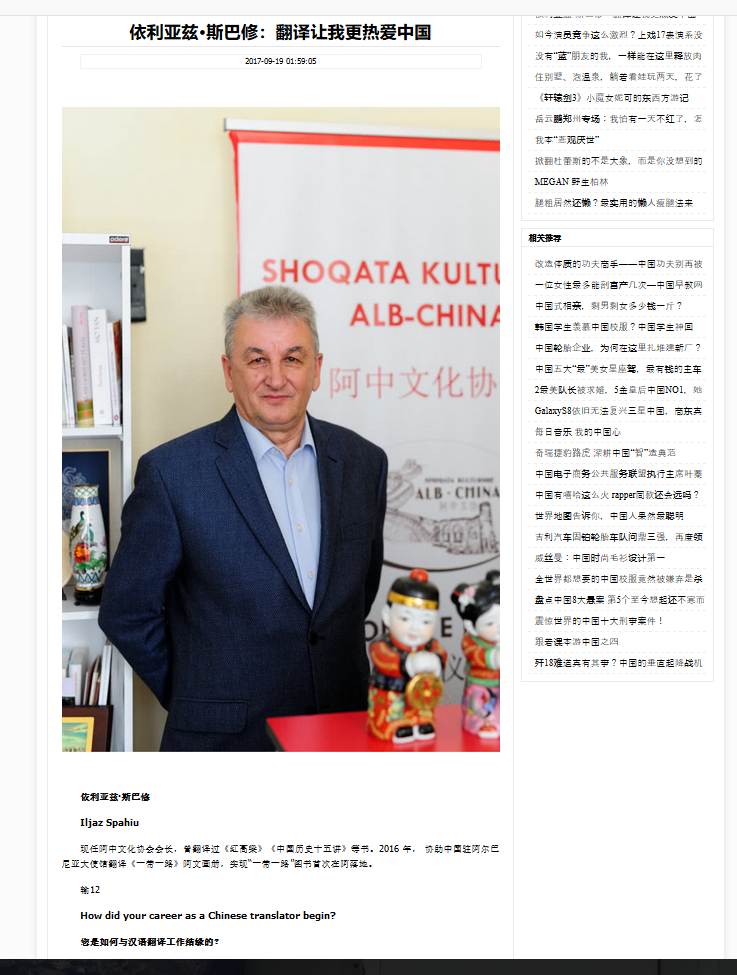
Here's a fascinating interview with Ilir Ikonomi (aka 依利亚兹·斯巴修), possibly the world's only literary translator from Chinese into Albanian: http://www.zmzjk.com/news/shizheng/201709/1952487.html
Supchina has developed a Chinese literature quiz that ranges from ancient texts all the way to modern literature. It was harder than I expected, but a lot of fun. See if you really know your Chinese lit!
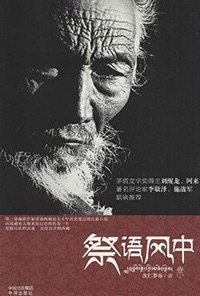
That evening I sat on a cushion in front of the open doors to Rinpoche’s room, reciting the Avatamsaka Sutra, the Thirty-Five Buddhas of Confession, and sections of the Shorter Sukhavativyuha Sutra. There, in Rinpoche’s presence, I felt cleansed of my foolish affections and jealousies. My heart was as pure as a swift-flowing mountain stream. At dawn I opened my consciousness up to Rinpoche. I felt waves of beautiful light radiating from him, like ripples emanating out over the surface of a pond, penetrating my flesh and gathering in my heart. I felt myself dissolve into the light. I saw clearly that this body was but a temporary residence. Only consciousness is eternal.
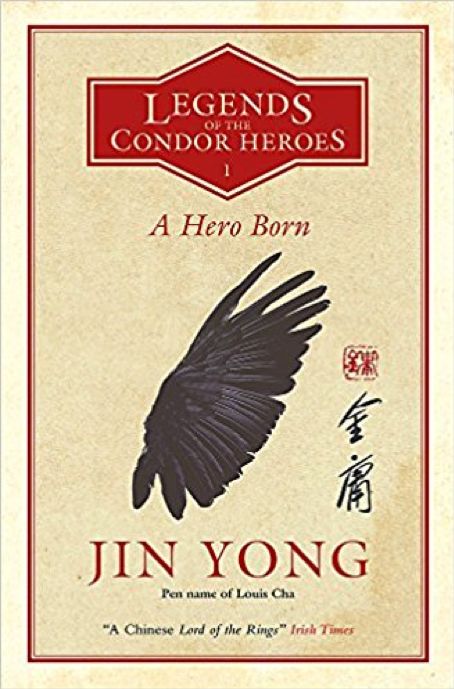
The first book of Legends of the Condor Heroes, A Hero Born, has now been brought to the English world by translator Anna Holmwood and published by MacLehose Press.
An event with Anna Holmwood in Guanghwa Bookshop, London on 18 April.
In the case of Jin Yong, the broad sweep of the story, the emotional worlds of the characters, the moral framework behind their actions: all these things translate very easily in my opinion. The parts that are more difficult are mostly in the detail, the elements of Chinese medicine or historical references that are perfectly obvious to a Chinese reader. And yet, it is my opinion that an English reader doesn’t need to understand everything on the same level as his/her Chinese counterpart. I would rather that a translation inspires a reader to explore something further than sacrifices the energy and flow in order to make every detail plain.
By Michelle Deeter, April 15, '18
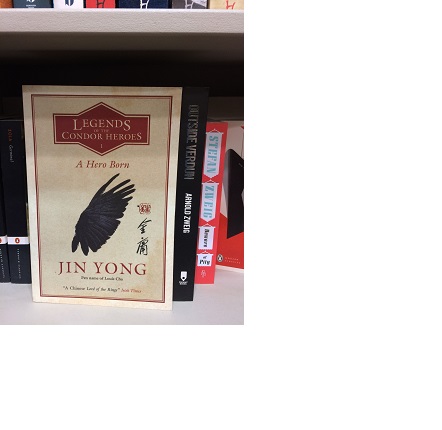
Spotted at Waterstones Manchester this week: "A Hero is Born" (Jin Yong, translated by Anna Holmwood on display in the window of Waterstones! Several excellent reviews have come out too.
This centuries-old trilogy in verse recounts the exploits of the legendary hero Manas, and his son and grandson in their struggle to resist external enemies — primarily the Oirat Mongols and the Khitan —and to unite the Kyrgyz people. Along with heroic tales such as Dede Korkut and the Epic of Köroğlu, Manas is considered one of the great Turkic epic poems.
Hm, it's more about publishing than translation. But!
The Man Booker International Prize said on Friday that it had changed the nationality of Professor Wu Ming-yi, 46, one of 13 authors on the 2018 longlist, from “Taiwan” to “Taiwan, China” after it had received a complaint from the Chinese embassy in London.
Chen Qiufan [陈楸帆], born in nearby Shantou city, learned about Guiyu’s environmental nightmare from a friend working in the electronics recycling industry. In his debut novel The Waste Tide (2013) [荒潮], 36-year-old Chen turns Guiyu into “Silicon Isle,” a homophone of the village’s name in Chinese. In the cyberpunkish wasteland, migrant workers dismantle prosthetic limbs, eyes, and even heads dumped by rich people, who can upgrade their body parts much like we upgrade our iPhones.
Chinese-language commentary on reception of Jin Yong's novel in the West.
Writer Li Juan shares her memory of a tense experience attempting to send a lengthy manuscript to her publisher from Xinjiang amid the nearly year-long internet blackout and security crackdown that followed the 2009 Ürümqi riots.
Chinese text: 记八年前的事
By Bruce Humes, March 26, '18
Speaking at length during his recent coronation ceremony, the new emperor mispronounced the name of the Tibetan epic, King Gesar, as "King Sager" (习近平把 “格萨尔王” 说成 ”萨格尔王”).
Unsurprisingly, this news did not appear under the headline "President Hurts the Feelings of Millions of Tibetans" in The People's Daily next day.
It is significant that he mentioned two of the three ancient oral epics in his speech, King Gesar (Tibetan) and Manas (Kyrgyz). Chinese literary apparatchiks increasingly refer to them, including Jangar (Mongolian), as “China's Three Great Epics” (我国三大史诗). This despite the fact that they originated in languages other than Chinese, among non-Han peoples and in lands that were not then part of the Chinese empire.
Alerted about it via a tweet by Shawn Zhang (章闻韶), however, Victor Mair's Language Log did discuss XJP's verbal faux pas that went unreported in China mainstream media.
More…
A plot summary barely conveys the extraordinary energy of this book. It blends real and fictional characters, teems with incident – reversals, unexpected meetings, betrayals, cliffhangers – and, most of all, dwells for page after page on lovingly described combat. To paraphrase Miss Jean Brodie: for those of us who like this sort of thing, this is the sort of thing we like. As martial artists square off, evocatively named strikes are responded to with equally evocatively named parries: Search the Sea, Behead the Dragon; Seize the Basket by the Handle; and, only to be used in extremis, the desperation move: Sword of Mutual Demise. The novel gives us the history of strange martial techniques, assesses the merits of different schools of kung fu, and describes the mysterious internal alchemy that gives rise to the most devastating physical force.
您怎么看翟理斯和韦利对诗歌翻译的争论?还有韦利和庞德的争论?诗人翻译和学者翻译的永恒战争有没有和解的可能?
温伯格 [Weinberger]:一种翻译既有来处也有去处。大多数学者翻译的问题是译者知道原文的所有涵义,但却不知道译文要去哪里——也就是目标语言的当代文学语境。在中国诗歌的汉学家译者中,有三位伟大的例外:韦利、华兹生,还有最近的大卫·辛顿(David Hinton)。他们是绝无仅有的译出了伟大英语诗的学者,因为三位都是他们时代英语诗歌的专家。(葛瑞汉可以算第四位,不过他只译了一本诗集。)值得注意的是,他们也都受到了那些只通些许中文的诗人译者的巨大影响,比如庞德、王红公、加里·斯奈德(Gary Snyder)等等。
The Stolen Bicycle (單車失竊記), a novel written by Taiwanese author Wu Ming-yi (吳明益) and translated into English by Darryl Sterk, has been selected to contend for the prestigious Man Booker International Prize.
The novel is about a writer who embarks on a quest in search of his missing father’s stolen bicycle.
Pen America's report looks at a variety of questions, including the impact of social media censorship on China's fiction writers. Here's an excerpt:
Case Study 3: Chinese Novelist Murong Xuecun
Murong had 8.5 million followers on his Weibo microblog accounts before they were shut down. He attempted to set up new accounts, which were repeatedly shut down as well. The effort of continually trying to evade the censors, Murong shared with PEN America, eventually “wore him out.” Supporting himself with his writing might have been possible if he had continued to toe the Party line through self-censorship. But having made the choice to speak out, Murong’s once-promising literary career is on indefinite hold.
“I sell fresh fruit online and deliver the fruit to my customers now,” he said. “My online store is called ‘Murong Mai Gua’ (Murong sells melons). I am working on my next novel, but I don’t know if it can be published. Four years ago, all my previously published books were pulled off bookstore shelves and I lost the ability to make any money from writing in China,” he told PEN America.
這是一次全中國都看到了的翻白眼。
The country’s media regulator – the State Administration of Press, Publication, Radio, Film and Television – was set to merge with the Ministry of Culture to create a super cultural ministry to expand the scope of China’s ideological influence, a source familiar with the discussions told the South China Morning Post.
Both bodies are overseen by the State Council, and the merger is expected to be part of a sweeping structural overhaul of the Communist Party and state bureaucracy to be unveiled during the National People’s Congress in Beijing on Tuesday.
By David Haysom, March 3, '18

The Beijing Bookworm Literary Festival is back, with a great line-up of events featuring international authors and some of our favourite local writers, including Xia Jia, Murong Xuecun, Ren Xiaowen, Sun Yisheng, and many more! Pathlight will also be represented at a translation workshop in collaboration with Spittoon magazine.
By Nicky Harman, March 1, '18

Chen Xiwo has some very interesting things to say about his short story 'Pain,' from his collection in translation, The Book of Sins, in a discussion on the Los Angeles Review of Books, with his publisher Harvey Thomlinson, LARB's editorial team, and me, Book of Sins translator.
By Nicky Harman, March 1, '18
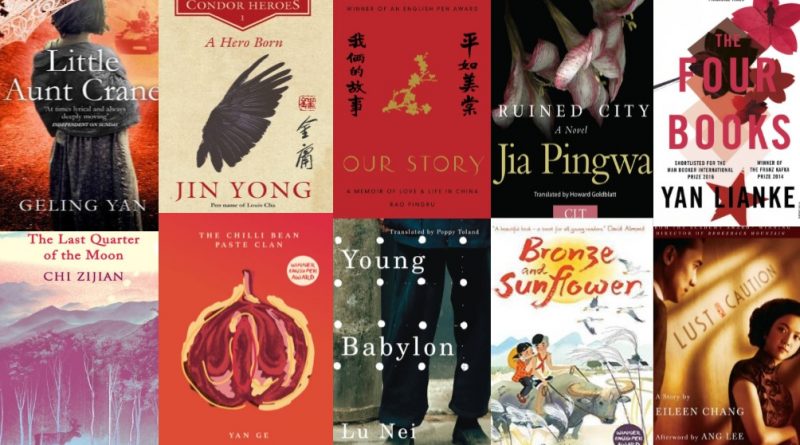
I was asked to produce a list of the ten best novels in translation for the China in Context book festival weekend, which focusses this year on translation. I managed to slip "of the" into the title, and have emphasised it's a very personal list. And I guess any publicity (for Chinese literature) is good publicity!
Chinese media report that prolific Xi’an-based novelist Hong Ke (红柯), who was long captivated by the multiethnic history of Xinjiang, died on February 24, 2018 (突发: 陕西著名作家红柯去世享年56岁).
He left his native Shaanxi for Xinjiang in 1983 and lived for a decade in the Ili Kazakh Autonomous Prefecture bordering on Mongolia and Russia. Although he returned to Shaanxi and took up university teaching positions in Xi’an, Hong Ke --- a Han who never mastered any language but Mandarin --- was deeply inspired by the cultural fusion he discovered in China's far northwest, and subsequently penned numerous novels and short stories set in Xinjiang that feature historical and legendary characters from China's various ethnicities. See here for his Chinese novels, here for an English excerpt from one of them, Urho (乌尔和), and here for excellent backgrounder on him in French.
“A Hero Born” is the first of the 12 volumes of “Legends of the Condor Heroes”, written in the late 1950s. Set in the years after 1205, it enjoyably wields the weapons of wuxia -- traditional martial-arts fiction, with its spectacular combat and pauses for philosophy -- to show Chinese identity under threat from foreign and domestic foes. “Three generations of useless emperors” have brought the Song dynasty to its knees. Quisling allies of the Jurchen Jin invaders, who rule the north, abet imperial decline.
Enter the dragons of salvation: an “eccentric” kung fu clan known as the Seven Freaks of the South, and the militant Taoist monks of the Quanzhen sect. They are first rivals, then collaborators. Though strained, their joint mission embodies a pact between “physical force” and the “more enlightened path” of wisdom that may rescue China.
The novel [The Stolen Bicycle] shows us the talent but also the personality of the novelist: his obsession with ecology is obvious as his passion for bicycles; he even toured Taiwan on an old collector’s bike to promote his novel! A specialist of butterflies, the novelist evokes the industry around them and collages made with their wings.
His family is a central theme and there are many references to the Chunghua Shopping Center where the family worked and lived. Finally, as in other books, he immerses us into the history of Taiwan, Japanese colonization and aboriginals but underlines: “I did not write this novel out of nostalgia but out of respect for an era I did not experience."
Nevertheless, the unifying theme of the novel is the search for a lost father whom the narrator hopes to find by his bicycles which were stolen or lost or abandoned.
(The book is reviewed in both French and English)
LiT Program residencies are an exceptional opportunity for international writers and English-language translators to create new work individually and in collaboration, to find a wider audience for contemporary writers through translation, and to participate in literary exploration and cultural exchange as members of the global creative community at VSC.
From The Metropole, 8 Feb 2018.
By Kristin Stapleton, a member of the board of directors of the Urban History Association and of the Global Urban History Project. She teaches history at the University at Buffalo, SUNY. Her research focuses on urban administration in China and representations of cities in Chinese fiction. She is the author of Fact in Fiction: 1920’s China and Ba Jin’s Family
By Helen Wang, February 4, '18
In 2016 Minjie Chen, Anna Gustafsson Chen and I started a blog/web-resource Chinese Books for Young Readers. We just posted our 60th piece. Thanks to everyone who has helped us along the way. Keep following!
-- See the full list with weblinks here
U.S. publishers cross borders to import more children’s books from China, as Chinese publishers create contemporary stories. - a long article by Karen Springen (paywalled)
Whenever I translate, I first read the original text carefully and internalize the ideas as clearly as I can, letting them slosh back and forth in my mind. It’s not that the words of the original are sloshing back and forth; it’s the ideas that are triggering all sorts of related ideas, creating a rich halo of related scenarios in my mind. Needless to say, most of this halo is unconscious. Only when the halo has been evoked sufficiently in my mind do I start to try to express it—to “press it out”—in the second language. I try to say in Language B what strikes me as a natural B-ish way to talk about the kinds of situations that constitute the halo of meaning in question.
Fiction bestsellers in China last year were dominated by non-Chinese authors, according to OpenBook, while homegrown authors sold better in nonfiction.
As nationalism continues to influence American politics, the National Book Awards adds a category for translated literature with ‘the power to touch us as American readers.’
Guidelines for censorship in the Xi Jinping Era have tightened considerably for all, be they bloggers, reporters or novelists, but for minority authors who wish to highlight the culture or challenges facing non-Han peoples within today’s PRC, the obstacles to publication and the list of “unmentionables” is even longer. Aside from a shortage of translators working from indigenous languages into Mandarin or foreign languages, there is also the subtle impact of state- and self-censorship that ensures certain “ethnic realities” are rarely depicted, be it in a magazine, book or online, in reportage or even fictional form. A Uyghur businessman who tries to book a room in Shanghai may be informed the hotel is full, or face interrogation from a policeman; a community of Mongolian herders may be conveniently classified as “ecological migrants” (生态移民), given negligible compensation and forced to relocate, in order to make way for a profitable mining project or power plant; and a rural Tibetan dweller may be refused entry to Lhasa, home to innumerable sites sacred to indigenous Buddhists, because he lacks a travel permit to enter the administrative capital of the Tibetan Autonomous Region.
Such real-life phenomena are contentious and perceived by the authorities as likely to breed “inter-ethnic” discontent, and when mentioned in literary works or reportage are heavily redacted or simply not published. Very occasionally, however, a minority author — as in the excerpt below — manages to skirt the censors and turn the spotlight on burning issues.
Congratulations to Aili Mu, with Mike Smith, for their book Contemporary Chinese Short-Short Stories: A Parallel Text (Columbia University Press, 2017)
- see which short stories were chosen here
“Somewhere in…” is a monthly column from the Global Literature in Libraries Initiative that addresses international censorship issues.
By Eric Abrahamsen, January 24, '18
Pathlight Magazine, a Paper Republic publication, is looking for a new
Managing Editor!
The position is about half time (though sometimes busier than others),
and based in Beijing. You will be working together (mostly remotely)
with Paper Republic editors, and with People’s Literature Magazine,
our Chinese partners. Responsibilities include:
- Keeping the magazine to a quarterly publication schedule.
- Working with Paper Republic and People’s Literature to
collectively choose a theme and a table of contents for each issue.
- Assigning and collecting translations.
- Editing translations, or assigning editing work to other editors.
- Doing social media promotion.
We’ll provide translator and editor resources, and help connect you
with everyone you need to talk to.
Salary is paid per issue, and is competitive.
Our ideal candidate:
- Is in Beijing.
- Is a Chinese => English translator. One of the strengths of
Pathlight is that our translations are edited by translators.
- Is organized, and not afraid to crack the whip.
- Is conversant with contemporary Chinese fiction and poetry.
- Has some familiarity with digital publishing, including using
InDesign and manipulating epub files.
- Has a bit of experience dealing with Chinese government-owned
institutions.
- Would be available to start in the next couple months.
Interested parties please email info@paper-republic.org.