


Something Cruel About Woolf
By Wang Yiting
Translated by Qing Zhao
I first heard of Woolf in my first year of high school, during one of those “Three Minutes Before Class” sessions. It was a particularly exasperating ritual at our school. The idea was simple: every class period, in order of student ID number, someone had to step up to the podium and deliver a three-minute speech. Of course, you also had to prepare slides. Everyone hated it. I mean everyone. I loathed it most of all.
Quiet by nature, I recoiled from crowds and grew uneasy in any gathering larger than three; standing before an entire classroom was agony. At fifteen, I was convinced no school-sanctioned torture could possibly exceed these sessions—until college introduced me to “presentations” and adulthood to performance reviews. I had, it turned out, been rehearsing for corporate life since tenth grade.
I hated public speaking then, and I hate it still. Whenever I address a room, my voice drops a register and takes on a faint tremor. I know people can hear it. But no one lets on, and I pretend not to care. I pretend it isn’t happening.
That day, it was her turn to give the little speech. I have forgotten her name, which is proof enough that we were never truly close, except that it was elaborate and striking. Something like Mu Wanyin or Mu Wenxuan, one of those rare, ornate surnames teenage girls coveted, tethered to characters that, however obscure in meaning, conjure a visceral lushness: a rush of moisture against the skin, the thick scent of foliage.[1] So poetic, so elegant, so much like literature in its primordial form.
I envied her. I envied her bitterly. But I was only Li Meihui. Neither 美荟 (荟, abundance) or 美绘 (绘, painting), not even 美彗 (彗, comet), just 美慧—“beauty” and “wisdom.” In those days, I envied any girl whose name left room for imagination. But with her, I knew my envy was a kind of cruelty, because Mu Wanyin—or Mu Wenxuan—was ugly. Startlingly, excessively so. A high school girl. A girl. Truly ugly.
She was fat, for a start. Not dramatically, but on her tall frame, the weight lost its girlish softness. During the summer cram sessions, she avoided skirts. The one time she relented, her hem rode up to reveal a stretch of brown ankle, the skin there coarse and bumpy like a plucked chicken. I’d looked away, stung by a vague embarrassment. She was dark-complexioned, and even her hair was a harsh, impenetrable black, dense as cast iron. Those two things alone would have been punishment enough, but adolescence has its own laws. It is a season uniquely ruthless towards girls, matched only by pregnancy, the onset of middle age, and menopause. Back then, her face was ravaged by acne, pimples swelling almost into pus-filled sores. Chin, nose, cheeks, forehead—they were everywhere. These stubborn, brownish-red growths seemed permanent, simmering like miniature volcanoes. Beneath it all, her features were blunt: a mouth slightly too wide; eyes that might have passed unnoticed had the sheer volume of her cheeks not crowded them out. Her nose was flat, though that could hardly be called a fault. Not that any of it was a fault. At twenty or thirty—when she was no longer so violently tormented by adolescent hormones or forced into an oversized uniform, and had enough time to wash her hair regularly—she might have passed for an ordinary-looking woman. She might even have developed a style of her own, one that commanded respect, and found many unclouded eyes willing to see and accept her. But this was adolescence. God, it was ten years ago. We were fifteen, shivering in the gales of our own inchoate, accumulating terrors. To me, then, her ugliness felt almost cruel. It would occasionally stir a strange, inexplicable sorrow in me. Yet she seemed indifferent. It was as if very little in the world mattered to her. She moved through the days with the unapologetic autonomy of a teenage boy—you know what I mean, right? It’s not that girls can’t be just as wilful or rebellious, but our ways always seem somehow different. Like feminine nouns in French: elusive, easily forgotten. What we do is harder to catch. Veiled, ambiguous, it leaves you uncertain whether any line has been crossed at all. We lack that outward destructiveness, but the damage we cause is just as real. Deeper, perhaps. And lasting far longer.
For example, our class had a QQ group, and many announcements were posted there for convenience. Almost everyone joined. Only she kept refusing, which meant she often missed important notices, but she didn’t care. And then there was her hair. Our high school forbade girls from wearing blunt bangs. If you insisted on having bangs, they had to be cut a full finger’s width above the eyebrows, which looked hideous. All of us girls in the liberal arts track grew them out in secret. Li Xue’er and I were no exception. We would pin them back before walking through the school gates, sleep with them in rollers over the lunch break, and by afternoon let them fall into soft, wispy fringes. Makeup was banned too, but we wore it anyway, on the sly. We got away with so many things, Li Xue’er and I. Everyone was like this. In place of foundation, we used a whitening sunscreen. Li Xue’er taught me a trick: if you layered it thickly down the bridge of your nose but left the sides bare, the sunlight would create a natural-looking contour. We had a workaround for lipstick, too: colour-changing lip balm. It went on clear, then bloomed into a sheer pink after a few minutes. It was subtle enough that even if a teacher cornered you with a tissue to wipe it off, nothing would show. But none of those rules meant anything to Mu Wanyin. She simply rejected them. She was the only girl in our class who openly wore heavy, blunt bangs. She wore lipstick, too—a bold, vivid red. Our homeroom teacher never intervened, never reprimanded her, and none of the other girls cried foul. We didn’t even dare to stop pretending we hadn’t noticed. Because that would have been too cruel.
So that day she stood on the podium, carrying her usual faint contempt and that unaccountable confidence, and introduced us to Woolf. She took us through Woolf’s books, through A Room of One’s Own, through her life, and told us how, in the end, Woolf had filled her pockets with stones, walked into a river, and just died like that. I had never even heard of Ophelia. That kind of death was something I had never known how to imagine; it felt almost like a fantasy.
She read a passage from Woolf with deep emotion, though I have forgotten what it was. I have always had a poor memory for Woolf’s words. I only remember sitting there in one of the back rows. The curtains had been drawn for the projector. In that misty half-light, I watched her, transfixed by a single question: How could she be so certain of the words in her mouth? She had the easy confidence of a boy. Even though she was ugly, even though I was so much prettier than she was, I could not muster it. Not then, and not for a long time after. Because she knew Woolf. She even knew about the three waves of feminism, while the rest of us knew nothing at all. And so the girl she was then—still so young, housed in that large, heavy body—could quietly let her feet leave the floor and rise into the air, hovering just a fraction above the rest of us. I suppose—no, I am almost certain—that she must have done this many times in private. Alone, she would force her eyes wide open, let her feet lift from the ground, and float there for a little while, gleaning from it a small, hidden happiness, almost illicit. It must have been her one clandestine act. A fleeting moment, but its afterglow would linger, stretching far enough into reality to insulate her from everything else, leaving only that happiness. Or so I imagined.
And perhaps it was also because there was no one at school she liked, no one she cared to please. I didn’t have that in me. I wanted to please everyone, terrified of making things awkward. That was why, in a crowd, I often found myself billowing helplessly like a white sheet pinned to a clothesline.
Most of the time, she hurried past alone. She would bump into people without seeming to feel it and keep going. I knew her better than either of us realised because I watched her. When my mind drifted in class, I would catch myself studying her without even knowing it.
Every Wednesday afternoon, we had two full periods of reading class—a luxury that would vanish by our second year. We were allowed to spend the entire afternoon reading in the school library. I always sat with Li Xue’er, my deskmate. She was clever in small, practical ways and attentive to her appearance. She initiated me into all sorts of minor, tiptoeing rebellions: the things I mentioned earlier, for instance, also how to take in the legs of our uniform pants and dodge the midday dorm inspections. Once, during geography class, we happened to be assigned to the back row. She led me off to cut class with her. It sounds harmless enough—almost every novel I read then had someone playing truant—but none of us had ever dared. Our high school operated on the punishing Hengshui model, which meant students essentially never left the main building all day.[2] Half my classmates believed cutting class was purely a fictional invention. Even our version of it didn’t involve breaching the school gates; we just found an empty room and hid ourselves away.
Li Xue’er was more extroverted, louder, always surrounded by people. During self-study sessions or between classes, she and her friends wove a boisterous net around my desk. I would sit in the middle, reading or doing schoolwork. I seldom joined their conversations, but inside that circle, I felt entirely safe.
During our afternoon reading sessions, the two of us would commandeer a table. We’d hit the restroom beforehand, ready to sprint the moment the bell rang so we could claim the desk at the very back—closest to the magazine rack, furthest from the teacher. Li Xue’er was obsessed with comic magazines; sometimes she’d stash her phone in her pencil case to watch Korean variety shows, thread the earphone wire up her sleeve, and sit there with one hand propping up her face, giggling quietly to herself. Beside her, I read Eileen Chang in a haze of enchantment. Every woman in those pages had a breathtaking name and a face to match. I was sick with envy.
After Mu Wanyin finished her “Three Minutes Before Class” presentation, we had another reading period. Li Xue’er had taken the day off, leaving me alone at our prized table. I laid out my pencil case and composition book to claim the space, ready to slip back into a blissful stupor in the world of Lute and Jiuli.[3] But when I went to fetch my book, it was gone—someone must have borrowed it. I drifted back to the shelves, looking for some other target.
I spotted a book with an apple-green cover. It was To the Lighthouse, a novel by Woolf, so I chose it. On my way back, I saw from a distance a great mass of brown occupying my table: Mu Wanyin had taken Li Xue’er’s usual seat. We’d never spoken before. I tried hard to concentrate on the book, though. I cared less for what was inside it than for its tart, apple-green cover and its inscrutable title. I’ve forgotten most of what was in that book. It passed through me like a loose, damp handful of thoughts, leaving behind a wet stain that quickly evaporated in the sun. I remember only a single sentence. It appears somewhere in the middle of the book, set apart on its own line in a smaller, different type.
Mr. Ramsay stumbling along a passage stretched his arms out one dark morning, but, Mrs. Ramsay having died rather suddenly the night before, he stretched his arms out. They remained empty.
That sentence pressed itself into my heart, indelible, and never disappeared.
“It’s beautiful, isn’t it?” Mu Wanyin said suddenly. I looked up and realised she was watching me.
After that, we grew much more familiar. There were good pockets of time. PE, for instance. Nobody actually did PE; it was essentially free time. Half the class stayed in the classroom doing homework, while the other half wandered the sports field. Or Friday evenings after school—because we had mandatory extra classes on Saturdays, Friday night self-study was optional. These were the genuinely good hours—rare gaps in our lives when we finally had a chance to slip free of the timetable. Liminal, unaccounted for, and full of loopholes, the ownership of these hours was so unclear, the time almost felt ours. In those openings, Mu Wanyin and I would drift into each other’s orbit without quite realising it and fall into conversation. We might talk for a long time, or only briefly. Little by little, she began to tell me things.
She gave me her QQ number and asked me to add her. She said no one she knew offline had ever added her as a friend. She frequently posted things she’d written on Qzone. Her writing was spare, and mostly very beautiful. Far more beautiful than she was. And then, out of nowhere, she would bring up everyday things: how she was planning to go on a diet, or how much her appearance sometimes weighed on her. Yes, she had those moments, too. She would say, “Huihui, you have it so good. Your hair is so pretty, you’re so thin, and you never judge me.” I never knew what to make of that. We seemed to have become friends, yet not quite; it wasn’t the kind of friendship high school girls usually had with one another.
One PE period, I went with Enqi and Wang Yu to the school store by the sports field to buy nuomici.[4] The two of them were my real friends at school, the sort of friends high school girls were supposed to have. As we walked past the field, we saw Mu Wanyin sitting all alone in the very first row of the bleachers.
“Look, Mu Wanyin.” Wang Yu raised a hand. From the glaring sunlight, she pointed straight into the shadows. A strange distance lay between them, neither close nor far.
“What do you think she does all day?” Wang Yu turned to ask me. “Why is she so mysterious?”
“How would I know?”
“I see the two of you together sometimes, doing who knows what. What do you guys even do?”
“We aren’t close,” I said. “I hang out with you every day. The two of you.”
“No, and Li Xue’er too,” Enqi said, chewing on her popsicle stick and shaking her head with great seriousness.
“Anyway, I think she’s weird,” Wang Yu said, as if that settled it. “But you’re alright.”
I said nothing. My steps grew slower. I lifted a hand to shield the lower half of my face. The sun was too strong; at least my bangs took care of the upper half. I’d forgotten to put on sunscreen the way Li Xue’er had taught me. I couldn’t bear this kind of blazing sun, I really couldn’t. I wanted to be in the shade.
“The sun’s too much. I can’t take it. I’m heading back to class.” I dropped my head, tossed my words at them, and broke into a jog. Then I heard Enqi add, with absolute authority: “Someone really ought to tell her she can’t put on lipstick like that. It looks terrible. She should wear nude. Or brown.”
I ran on, my head still down. I knew that Mu Wanyin had seen me. She no longer wore that abrasive indifference she usually turned on the world, the way she bulldozed past everyone else; instead, she gave me an enigmatic smile. I was running too fast. I was entirely focused. I saw nothing at all.
※
I sometimes sneaked off to the empty classroom alone, behind Li Xue’er’s back. In truth, I preferred my own company to hers. But that day, when I pushed open the door, I was startled. Someone was inside—Mu Wanyin. I had always assumed the room was Li Xue’er’s exclusive domain.
“What are you doing here?” I demanded.
Mu Wanyin, however, looked delighted. “Huihui, come here, quick!”
I walked over, and she shoved a book into my hands. Woolf again. The cover was mostly brown with a splash of pink, not nearly as lovely as the apple green, and less alluring to me. The title was The Common Reader—a name that rivalled To the Lighthouse in its pull.
“Little Huihui, what brings you barging in like this? I just finished the book, so you can have it. You’ll love it, won’t you? My dear little Huihui, you have such exquisite taste.”
I’d only recently discovered how remarkably enthusiastic she could be. She liked calling me by these cloying, almost sickening pet names.
It was spring, and the weather was just beginning to turn warm. The wind was still strong, but there was a different texture to it. It had gone soft, making you brave; even when it roared and surged, it no longer seemed frightening, lifting the heart. I held the book in my hands. The cover stock was Genia, a high-end textured art paper finished with matte varnish and left unlaminated. Yes, I know this now. I remember the wonderful feel of it, though it took me years—many, many years—to finally learn its name: Genia. Slowly, I came to learn every detail. And there I was, holding my palms open in a gesture that felt almost sacred, allowing her to place the book right in the centre. She said, Look how high up we’re sitting. Doesn’t it feel like our souls are floating?
I smiled to myself, quietly pleased. I had guessed right. When no one was looking, her feet would slip free of the ground, and she would hover in midair for a little while. Just like now.
She was still wearing that bright red lipstick, smeared on carelessly. Remembering what Enqi had said, I asked her why she chose such a loud shade.
“Because it’s a gorgeous colour. It suits me.”
“But nude tones are very popular right now,” I insisted. “You’d look so much better in a nude—honestly. The teachers never bother you anyway. If it were me, I’d go with a nude. Something muted, an orange nude with a grey undertone.”
I was being sincere; it would have looked better. I’d been desperate for an orange-toned lipstick ever since Li Xue’er told me that with my complexion and face shape, an orange lip would look amazing on me. Besides, it was obvious: the vivid red only made her dark, brownish skin look muddier, made her mouth seem even more out of proportion, and left anyone who looked at her feeling faintly embarrassed. I wished she would do something—anything—to improve her appearance, even just a little.
It was strange. She didn’t seem troubled by it at all, but I was the one getting worked up, so much so that I didn’t know what to do. Deep down, I found her repulsive, and at the same time I felt awkwardly ashamed of feeling that way. But revulsion was the stronger instinct, and I was good at lying to myself.
Mu Wanyin laughed—that open, hearty laugh of hers. “Little Huihui, you know absolutely nothing about lipstick. Truly.” Then she mimed taking a drag from a cigarette and blowing smoke rings into the air with effortless cool. She kept laughing, shaking her head with a touch of triumphant pride.
“A true red is absolutely my colour,” she declared, with total authority. As if nothing had happened at all.
※
There is something I need to make clear before going further. Mu Wanyin had a certain trait—or at least, I suppose it should be called a trait rather than a fatal flaw. I didn’t realise this until much later. I was too young then. We were all too young; it couldn’t be helped. We tended to imagine things as far more terrifying than they were. In a school like ours, there were simply too many people, too many adults, too much of everything. Everyone walked around pretending to harbour terrible, unspeakable secrets, which only made the world loom larger and more impenetrable. And girls—women in childhood, women in adolescence—were too easily made timid. Back then, they felt compelled to protect themselves with great effort. They had to defend the very legitimacy of their existence against a colossal, labyrinthine system of rules, against an outside world that was always watching, always judging. It was as if they weren’t supposed to exist at all, and only by shrewdly deciphering every single rule could they earn the right to be there. Only then could they ensure that their small, fragile selves—or the selves they believed to be so fragile—would not be crushed to dust by that vast, unforgiving machinery.
In truth, all of this was born entirely of ignorance. Ignorance of the fact that they possessed power. This cruel, astonishing truth was something they would have to discover for themselves over the course of a long life, with great effort and immense difficulty. That was just how it was. If only some kind soul had quietly let them in on it then, just a little, things would have been so much simpler. Truly. The power of young women had been sealed away for far too long, with almost the same force one would reserve for the most dangerous, most uncontrollable demons.
And there was something eccentric about our Wanyin, something that frightened girls like us more than it should have: she was a little dirty. Not in any metaphorical sense; she simply wasn’t very good about hygiene. Perhaps she was too deeply submerged in her own world, or perhaps she didn’t have the time, or perhaps no one had thought to remind her. Whatever the reason, it was no big deal. There were almost always oil spots on her clothes, little black or white stains, traces of food, wall plaster, dust—all of it. And, as I’ve mentioned, her bangs hung in greasy clumps. Because she rarely washed her hair, they were soaked through with oil, which meant you could see large flakes of dandruff near the crown of her head. I generally pretended not to notice. I didn’t dare react. I simply hadn’t seen it.
Anyway, that was about the size of it. She was just a girl who wasn’t very clean.
“Don’t you think she looks like a chimpanzee?” Li Xue’er said abruptly one day, between classes.
“What?”
“Her. A chimp.” Li Xue’er tipped her chin towards Mu Wanyin, who had just walked past. “Or a savage. She really looks like one.”
I froze, at a loss for words. A few vague sounds caught and rolled in my throat. Then everything carried on as normal.
Until the day we rotated seats—Li Xue’er and I ended up sitting diagonally behind Mu Wanyin, separated only by an aisle just wide enough for a person to pass through. It was history class. As usual, Li Xue’er was hunched over her desk, reading The Peerless Demon Consort, a romance web novel she’d hidden in the compartment underneath. It was already the third book in the series, following The Peerless Delicate Consort and The Peerless Pampered Consort. Her verdict was that it was too melodramatic, that it lacked the class of the first book, and that the author was going rapidly downhill.
I wasn’t paying attention to the lesson either. I’d tucked The Common Reader under my history textbook, leaving only a few lines of text visible. The two of us were completely absorbed in our own worlds.
“She’s so disgusting.” Li Xue’er suddenly jabbed me with her elbow.
“What?”
“Her. She’s seriously disgusting. Did you see her bra strap? It’s gone all dark.”
I looked up, following Li Xue’er’s gaze. Mu Wanyin had her head bowed, exposing the coarse skin at the nape of her neck. She was wearing a halter bra. A section of strap that must once have been pale yellow had darkened to a shade somewhere between army green and brown. The stains were glaringly obvious, the kind that had clearly built up over a long time. Her exposed stretch of skin wasn’t much better. It was dotted with red, pus-filled bumps, some scratched raw, some crusted over with dirty scabs. To put it a little cruelly, the whole sight reminded me of a bloody sanitary pad.
I desperately wanted to do what I’d done the last time—play dumb and pretend I had no idea what was going on. But Li Xue’er was watching me intently, her face full of expectation.
“Yeah, she really is dirty,” I heard myself slowly say, my hands clutching The Common Reader.
“It’s so disgusting. Is she even human? Look! Ah! A flake of dandruff just fell. See? Did you see?” Li Xue’er wasn’t finished. She slapped my arm, exactly like she did when we were just messing around. Then she let out a wildly exaggerated blech that was frighteningly convincing. I knew she wanted me to laugh along like I usually did, I was supposed to gag too. She had no idea what she was asking of me.
“She’s so dirty! She’s such a freak. That’s why nobody talks to her. I bet she doesn’t have a single friend in this class, right? Blech.” Still not done, she made the sound again, louder this time.
“Blech. Hahaha.”
And then I did it too. The sound was incredibly realistic, as if I was genuinely about to throw up. It came out too fast, too easily, too naturally. Before I could feel anything at all, a sudden tightness in my throat had already spread to my skull and my hands.
Only then did everything before me come into focus: Mu Wanyin had turned around. She’d seen every single one of our fake gags. Li Xue’er flashed me a brazen smirk, buried her mouth in her sleeve, and tried hard to stifle her laughter. I, however, had nowhere to hide. Mu Wanyin had caught me red-handed.
For a moment, our eyes were locked. My face burned, as if that pitiless sun from days before had shifted and was now aiming its glare directly at my forehead. I felt I had no choice but to be baked and melted into a puddle of foul-smelling water. That was exactly how it felt.
It happened to be the tail end of the afternoon. The setting sun had turned its face towards us, sending a slanted beam through the window. It passed through Mu Wanyin’s face, and through mine as well. I couldn’t tell which sun—the one I remembered, or the one already fading—was bearing down on me.
I could guess how she’d react. She’d roll her eyes at both of us, or perhaps just at me. Or she’d look wounded and resentful. Any of those expressions would have looked right on her face. I knew that.
Then I saw her smile at me. She flicked her eyes towards Li Xue’er, who had turned away, and gave me a helpless, reassuring smile, very, very gentle. I knew what she meant. She understood what we were doing, understood it completely. There was no way she could have missed it. And yet she was trying to comfort me.
Inside, I felt a sharp prick, like a tiny cut from a raw paper edge, seeping with my sweat. I wanted so badly to run and escape both of them—no, escape all three of us—but I couldn’t. I’d always had the impulse to look away from scenes of violence, but not this time. And I knew that all I had to do was offer her a smile in return, or even just a shrug. But I didn’t. I simply couldn’t do it.
I looked down to keep reading, only to realise that I’d stained her book. Along the bottom margin of The Common Reader was a brownish-red mark. It was faint but large, the colour bleeding outwards into the page. The paper really had cut my hand, I had been sweating heavily; sweat mixed with blood and fell onto the page like salt, dissolving into a smudge that would never come clean. I’d always believed that only paper still raw at the edges, still unfamiliar to the hand, could cut your fingers. Which meant this book didn’t recognise me. We must still have been strangers to each other.
After that, for reasons I don’t know—I truly don’t—I never approached Mu Wanyin to talk again. At first, she would still wander over to my desk before PE or evening self-study, calling out, “Little Huihui.” But I barely responded anymore. I answered perfunctorily, pretending to be busy with something else, until she stopped coming around. When we passed each other in the halls, she would still cast that enigmatic smile at me with her eyes, but I would pretend I hadn’t seen a thing, barrelling straight past her as if she didn’t even exist. I still don’t know what my fifteen-year-old self was thinking, or why I did it. But that was how it was. That was what became of us. Later, when we were split into the liberal arts and science tracks for eleventh grade, we never saw or spoke to each other again. And now I’ve forgotten her name. It’s entirely possible that, in telling this whole story about her, I’ve gotten her name completely wrong.
I never finished that copy of The Common Reader. In fact, I never opened it again. I remember clearly that I stopped at the chapter “Rambling Round Evelyn.” One day after school, when the classroom was nearly empty, I slipped the book back into her desk compartment. As always, it was stuffed with snacks and books, cluttered, and a little dirty. Even after I grew up, I almost never opened another book by Virginia Woolf. It was as if—I can’t tell you why—I’d already read them all long ago. I don’t know what part of me convinced myself of this. I’ve always felt there was something cruel about Woolf.
[1] Mu (穆 or mù) is a relatively rare Chinese surname whose character suggests solemnity, reverence, and harmony, with faintly archaic associations of ancestral ritual, generational order, and noble posthumous titles. For many Chinese readers, it may also evoke figures such as Mu Guiying, the warrior heroine from the legends of the Yang family generals, and Mu Nianci from Jin Yong’s martial arts fiction.
The given names Wanyin (婉茵 or wǎn-yīn) and Wenxuan (雯萱 or wén-xuān) both have a distinctly literary feel: 婉 means gentle or graceful; 茵 refers to a soft mat or lush grass; 雯 means cloud patterns or coloured clouds; and 萱 refers to the daylily, traditionally associated with the easing of sorrow.
[2] A notoriously gruelling, exam-centred approach to Chinese high-school education. Originating in Hebei province, the model is characterised by militaristic discipline, rigidly managed schedules, and an intense, singular focus on preparing students for the gaokao, China’s national college entrance examination.
[3] Lute and Jiuli are semi-autobiographical stand-ins for Eileen Chang: Lute is the protagonist of The Fall of the Pagoda, while Jiuli—rendered as Julie in the English translation—is the protagonist of Little Reunions.
[4] Nuomici (糯米糍 or nuò-mǐ-cí) are chewy glutinous-rice sweets; here, the term refers to an inexpensive northeastern Chinese frozen treat with an ice cream filling.
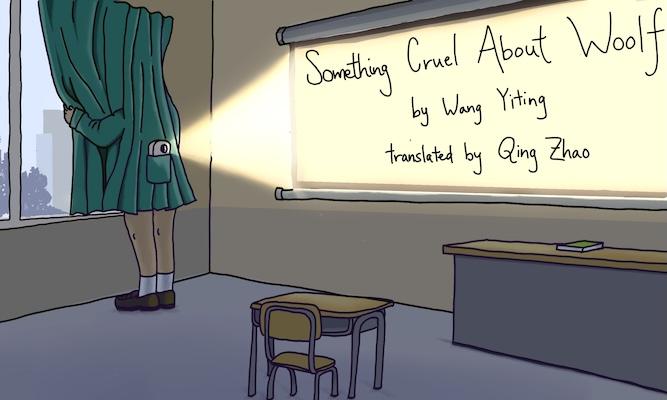
Cover illustration by Hal Y. Zhang.
Comments
There are no comments yet.