


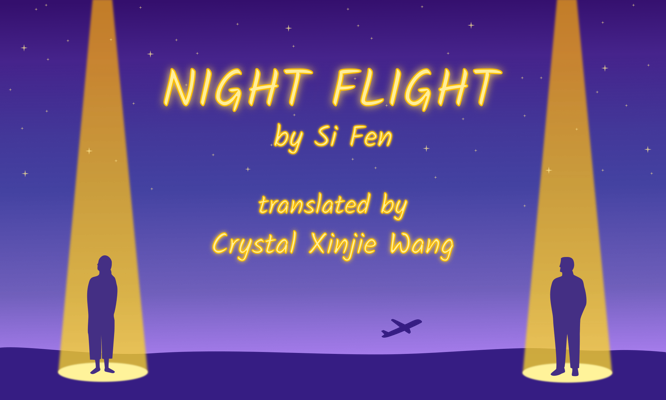
Night Flight
By Si Fen
Translated by Crystal Xinjie Wang
In twenty-four hours, Miya would see Hezhou again. Just nine hours to cross seven thousand kilometers. It had been the same on the way over, southeast China to eastern Europe. In the morning they had been close enough to touch, while by sunset one of them was in another country, dropping from one precisely locatable street to another seven thousand kilometers away. Two tiny points connected within the space of a single day. In that moment, there was only one person in the world who had seen the view from both places, who had breathed the entirely different air of both within twenty-four hours. Just thinking about it felt like a miracle. It had given Hezhou the idea that seeing each other once a week might not be so hard.
The flights are really expensive, you know.
Miya had sent the message while waiting in line for customs, her life seemingly extended by five hours out of nowhere. It was already the next day for him.
Still awake?
No worries. I usually don’t fall asleep until after one anyway.
It hadn’t sounded like he was joking. If he could have afforded the airfare, he really would have come once a week. Nine hours of long-haul flying each way, all that exhaustion, yet he’d have been willing to put up with it. Miya handed her passport to the customs officer and followed the immigration procedure, having her photo taken and leaving fingerprints at the machine beside her. A tiny piece of evidence that she had entered the country at that one particular moment.
“I can’t believe I get to see you tomorrow. Thank goodness for airplanes!” Hezhou was beaming on their video call.
“Ugh, why can’t tomorrow just get here already?” said Miya.
The thought had been echoing in her mind. Morning, noon, and night. Before meals and after. Before sleep and again on waking. Before their video calls, and once more after they hung up. And at other times too — in class, at the supermarket, on walks, listening to music — her whole mind pulled by a current moving toward tomorrow, everything in the world flowing like a silent flood toward this single meaning: Just get here already. She didn’t mind it.
Outside her window, the Norway maples glowed with a green as vivid as medicated oil dabbed at the temples. Bright, piercing, alive. Through every pore to the very core, it seemed to yank her into wakefulness from the inside out. It was only seven, and the sky was fully light. The sunlight lifted the curtain. Miya opened the window and switched her phone from front to rear camera. “Look,” she said to Hezhou, “isn’t it gorgeous? It’s so green!” The window faced a pedestrian path through the residential complex below. A woman in short sleeves walked along it with a corgi.
“Wow! Your room really has such a great view.”
He’d said this many times before. Back in February and March, he’d seen the snow through this same window, never stinting on a “so beautiful” each time. Miya smiled, switched back to the front camera, set her phone on the desk, and began to change clothes.
“I’m getting changed.”
“Okay.”
She never missed a chance to remind him. For a second or two, just a fleeting instant, she had nothing on. While the camera pointed at the ceiling, would Hezhou be picturing her, out of frame, taking off her clothes and putting on another set? She’d half-meant to angle the phone in her direction but had failed to pull it off. She’d been wearing a nightdress with nothing underneath. She imagined herself deliberately lowering the neckline, letting the sunlight touch her bare skin, making it look beautiful and fair. In this version of events, her hair would be loose, casually half-pinned, half-falling over her shoulders.
“You’d look beautiful with your hair down,” Hezhou said. “You don’t usually wear it that way.”
“It gets in the way. It falls into my food when I’m eating.”
Miya spoke unhurriedly, then took off her hair tie and looped it around her wrist, gathering up her loose hair.
She changed into a beige off-the-shoulder knit top with long sleeves and a pair of dark brown vintage flared trousers, so she wouldn’t be too cold or too hot at any point in the day. She quickly grabbed her phone, picked up her handbag, and went out. The moment she stepped outside the building, summer hit her in the face. As she moved through mottled tree shadow and sunlight, the scenery around her kept streaming past.
On the other side of the screen, Hezhou was eating lunch, his phone propped up with the camera facing him. Every now and then he glanced at the screen and smiled. A trace of oil made his lips glow an unusually vivid red, and when he smiled the fullness beneath his eyes stretched into long crescents. Such beautiful curves, Miya thought.
At quarter past seven, it was still a bit cold out. A middle-aged man suddenly shot ahead of Miya, brushing her as he ran along the narrow path. He had a prominent hooked nose, sagging skin, and wore a tight sports vest and running shorts. Miya had her earbuds in and hadn’t noticed him approach. Even after she did, she couldn’t decide whether to be annoyed. The air stirred by his passing lifted her gaze and carried it forward, down the path lined on both sides with Norway maples. She lived in Building 11 and was already at Building 5. She was walking quickly; in two more steps, she’d be at the primary school. Russians seemed to like building schools and kindergartens inside residential complexes. The school wasn’t yet open. The building was low, only four stories, and in front of it, behind a fence, was a small sports field. Miya pictured little Slavic schoolchildren out there playing football, like a flock of lively cockatiels.
She kept going, out of the residential complex and onto the road. A sky-blue trolleybus came rolling in, with almost no one on it. Miya quickened her pace. The bus stopped, and she took the chance to press the button and step aboard, without even checking the route. It didn’t matter. None of that mattered. May in Moscow flowed into the veins of the leaves, pulsing beat by beat. The green-and-blue streetscape began to ripple. She could go anywhere, ride a few stops, come back, then ride a few more. Only happiness mattered, a happiness as robust as a stack of firewood, made entirely from early-summer trees, full of potential. Yes, exactly that.
Hezhou had gone back to his dorm and propped his phone on the desk. “Ah, these Di li she apples I bought today are so good.”
“Di li she apple?” Miya asked, “What’s that?”
“It’s the Red Delicious apple.”
“So Delicious becomes Di li she?”
“Exactly, that’s why it’s called she guo, snake fruit. That’s where the name comes from.”
“What maniac came up with that transliteration?”
Miya watched Hezhou eating his snake apple through the screen.
“Where are you off to today?” he asked.
“Just walking around.”
“Okay. The weather looks so nice, perfect for a walk.”
“Is Shanghai insanely hot right now?”
“Hot and muggy, and raining. You don’t get skies like this in Russia.”
Hezhou shook his head dramatically.
Miya laughed and shifted how she was holding her phone.
“Just reminding you one more time: I land at 12:30 pm tomorrow! Come pick me up! Don’t get the time wrong and don’t be late!”
“How could I possibly get that wrong?”
Hezhou leaned closer to his screen and checked the flight screenshot in their chat history.
“Okay, then. Go to sleep. Take a longer nap at noon,” Miya said. Hezhou called her every night until one in the morning, and she often worried he wasn’t getting enough sleep. But he claimed that he used to be on his phone until one anyway, that he couldn’t fall asleep any earlier, and now he was simply spending that time talking to her instead, so there was no need to worry. She remembered him mentioning once that he was the type who fell asleep the moment his head hit the pillow and slept straight through to the alarm. Generally speaking, people without sleep problems seemed to need a lot of sleep.
After hanging up, Miya put on some music, a lesser-known acoustic track by a hugely popular Korean girl group. She loved its vibe, the way the guitar strings resonated with its wooden body, like honey water two degrees above body temperature, accidentally spilled onto your hand and leaving a faint, impossible-to-scrub-off stickiness on the surface of your skin. She felt only lukewarm about the group itself, hardly a devoted fan, but she had latched onto this one song and played it over and over. There was something beautiful about listening to a song full of feeling in a language you couldn’t understand.
It was a little like her occasional romantic tactic with Hezhou. He didn’t know Russian. Sometimes, during their calls, she’d say a sentence or two in Russian that had nothing to do with their conversation. Hezhou would ask what she’d said and joke, “You weren’t cursing me out, were you?” Miya would pretend to be angry.
“Why would I do that?”
Hezhou shook his head with a sigh.
“Next time we call I’m running a translation app.”
He asked her how to say “I love you” in Russian.
“Do you want to hear ‘I like you’ or ‘I love you’?”
“Hmm, that’s a serious question. ‘I love you.’”
“Я тебя люблю. Я люблю тебя. Тебя я люблю. Any of them work. You can drop the “Я” too.”
“Why is it so long? Say it slower.”
“Я люблю тебя is fine. The word order is more like Chinese.”
“Okay. Ya lyo-bu-lyo jeh-bi-ya.”
“Yes, that’s about right!”
Holding her phone, Miya laughed happily on her bed.
※
It was Hezhou who had said it first.
As the bus approached an intersection, Miya saw two teenagers on the opposite side of the road, walking hand in hand. A girl and a boy, both thin and tall, with light blond hair, around fourteen or fifteen, wearing backpacks, canvas sneakers, and jeans. Where were they going this early? The bus turned right. Miya craned back through the window and thought she saw them stopping at the crosswalk to kiss.
They were probably still in middle school. How nice. Roughly speaking, she and Hezhou had also met in middle school. She was in Class 4, and he in Class 3. They barely knew each other then, only crossed paths during the break exercises. Hezhou was in the last row of Class 3’s formation, and Miya in the second row of Class 4’s. Over three years, they grew familiar by sight but never spoke, let alone found out each other’s names. It wasn’t until they ended up in the same high school class that they could finally put names to the faces they’d been familiar with for years.
However, even then they didn’t have much to do with each other. Miya was an announcer at the school radio, reading two essays by notable writers every Thursday afternoon during the 6 p.m. dinner hour. A few lines, then a pause, a few lines, then a pause, the rhythm measured and deliberate, with background music of her own choosing. At a boarding school where high schoolers had surrendered their phones and had little entertainment, they came to treasure the chance to have a song played, a small occasion to look forward to in their everyday lives. Miya and the other school radio members were often bribed with snacks and milk tea, or with online video-streaming and music app memberships, in exchange for song requests. For requests that carried real significance or involved some unspeakable circumstance, they’d often do it for free. Hezhou had come to Miya once, wanting to dedicate Coldplay’s “Yellow” to his girlfriend.
“Treat me to some oden for a late-night snack at Canteen No. 1,” Miya said.
Hezhou stood in front of Miya’s desk and nodded vigorously. Miya made him shell out quite a bit, requesting three crab-roe lucky bags.
“Nobody’s ever dedicated a song to me, not even on my birthday,” Miya said.
She was walking a little ahead of Hezhou. They’d just stepped onto the bridge. A few cars sped past. Oddly enough, there wasn’t a pedestrian in sight. Winter. Clear, dry, cold. She’d wanted to mention it for a long time, but an impulse like that was like meat put away in the freezer, becoming immortal in the cold and quietly slipping from memory, only to reappear the next time you cleaned out the fridge.
The scene that followed would remain firmly inscribed in Hezhou’s mind: the camphor trees still green, Miya in a camel cashmere coat, with a brown shoulder bag, moving through the cold, dry air, the wind blowing now and then, her hands shoved into her pockets, her body tilted slightly backward, with her hands tugging down hard on her coat. Looking a little cold. She turned around and looked at him.
What did he say then? Sorry? No, that wasn’t it. How could she have forgotten such an important moment? And yet she had. The moment passed, and they went to eat. Grilled fish, mala flavor, over a layer of potatoes and hot-pot glass noodles, braised until soft.
“Let me walk you home,” Hezhou said.
Miya nodded. They’d both had a bit to drink.
“The subway closes at eleven, right? Will you be okay getting back?”
“No worries,” said Hezhou. “It’s fine. Are you cold?”
He took Miya’s hand.
“Not too bad. When it’s below zero in Moscow, I still don’t feel the cold.”
“You’re something else.”
“Come on, those guys at school used to keep the AC at sixteen degrees, and I never even felt it.”
“I remember that. Whenever I sat in the back, I’d bring a jacket.”
“You want my coat?” Miya asked, eyes narrowed.
Hezhou patted her shoulder lightly.
“You’ll catch a cold.”
“Oh,” Miya said, “you remember Xiao Gao and Li Jie? They got together.”
“Those two? When?”
“They both got into K University, kept running into each other, then clicked. It was Xiao Gao who made the first move.”
“No way! I never would have guessed.”
“Really?”
“You said they got together. Does that mean they broke up?”
“Yeah. Xiao Xie told me. Li Jie cheated.”
“Hard to imagine those two having that much history. I barely remember them talking to each other.”
“Ha ha. You really don’t keep up with any of your old classmates.”
“Any more gossip?”
“You go first. Wait, how did you and your girlfriend end up breaking up? Was it the distance?”
“Not entirely. Just felt like we’d gradually become strangers.”
“And then you broke up?”
“Yeah. We ended things amicably.”
“Oh, I think we’re almost here,” Miya said.
They went up together. A kiss. Lying together. “Not tonight,” Miya said. The bed was a leaf turning in circles at the center of a pond. “Okay,” Hezhou said. “I’ll always respect your decision.” The alcohol slowly spun out from the bottom of the pond, crystallizing into a beautiful suspense. That suspense flew seven thousand kilometers the next day, crossed the Ural Mountains, and vibrated at a startling frequency, its amplitude minute, like a hummingbird hovering within a human retina.
Over the years, Hezhou and Miya had maintained a tenuous connection. When Hezhou passed his graduate school entrance exams, he posted about it on WeChat Moments. Miya’s avatar popped up among the notifications, a cute cartoon cat. Hezhou pictured Miya behind it: small face, big eyes, a fine and delicate nose, with much the same air as the cat. Thanks to social media, they only chatted occasionally, yet Hezhou felt that Miya’s digital spirit was always wandering around him, as though they were never truly apart. Time moved differently between different people. For friends who weren’t part of your daily life, you unconsciously filled in the gaps with imagination, and the image of them always remained younger, more nostalgic.
Before they became a couple, Miya messaged Hezhou out of the blue about a film.
Oh my god, the male lead is so much like you. Have you seen it?
Her words were wrapped in a pure white chat bubble, accompanied by a movie poster.
No.
You should watch it.
Miya sent several screenshots. The characters in them were all white, with high nose bridges and fair skin. Hezhou couldn’t tell to what degree Miya meant the resemblance with the lead. He was somewhat curious but didn’t want to ask anyone else for an opinion. In itself, it didn’t seem like a secret, yet it carried the atmosphere of one. Once shared with someone, that soft, plant fuzz-like atmosphere would easily vanish without a trace.
Hezhou found a copy of the movie and watched it. It was a science fiction set in a near-future dystopia: Earth covered in a thick, eternal cloud of dust, sunlight unable to reach the surface, energy depleted, plants withered, animals extinct, humanity having to survive in endless winter. To conserve resources and maintain productivity, the survivors’ base assigned each individual a specific role. The male lead, numbered ib2369, was responsible for engineering maintenance. In the ruins of a long-forgotten factory, he discovered an abandoned cryogenic chamber. Inside was the female lead, who came from the “pre-disaster” era — the 2020s. ib2369 woke her. Her name was Lisa. She told him about the world that had existed before and gave him the name Tucker. The world that once was opened itself to Tucker like a dream. Tucker and Lisa planned to escape. In the end, the two of them disappeared into the vast white winter beyond the base, not knowing whether they would live or die.
Hezhou messaged Miya, I finished it. My favorite scene was when Lisa drew the moon for Tucker.
Mine too.
What makes you think I’m like Tucker? Hezhou asked.
Certain moments, I guess. I always feel you’d react the same way. And the actor’s expressions, they’re strangely similar to yours. I’ve seen him play other characters, but I never get the same feeling.
I really like Lisa, Hezhou said.
I knew you would.
Hezhou asked Miya how she was doing in Russia. She said fine, but it got dark too early in winter. By two or three in the afternoon, the light was already fading, and the roads were icy. Every day, she came home from class to a dark sky, which made her feel she was working terribly hard, even if she hadn’t actually been studying for very long.
I saw the photos you posted on WeChat Moments. They were beautiful. I’ve never seen that much snow, Hezhou said.
I felt the same at first. But it was only novel the first time I saw it. I’d rather it didn’t snow.
Do you have a winter break?
Yes, probably at the end of January. I’m coming back then.
We’re on break by late January too. If you have time, want to go out for a meal?
Sure.
Hezhou and Miya weren’t in the same city. More precisely, their parents weren’t in the same city, and two graduate students briefly home for the Chinese New Year had no convincing reason to stay somewhere on their own. On the fifth day of the New Year, Hezhou used the excuse of catching up with some high school friends (which was technically true) and took the high-speed train from R City to Y City. He and Miya watched a New Year film and then went out for hot pot. He’d bought the movie tickets in advance.
“How about this?” Miya said. “You buy the movie, and I’ll get dinner.”
The hot pot restaurant they’d found online was so popular that there were no seats when they arrived, so they took a number and waited. Plastic chairs were scattered in a loose circle around the entrance. Miya and Hezhou sat down together, chatting as they waited their turn. A young couple sat nearby, looking a little more grown-up than the two of them. The woman leaned her head on the man’s shoulder and showed him funny videos on her phone, making them giggle nonstop. In other people’s eyes, maybe Miya and Hezhou were just another couple out on a date who hadn’t thought to book a table in advance. In a shopping center with people flowing past in every direction, what kinds of connections existed between one person and another? Miya was sitting very close to Hezhou. He caught a scent from her, but couldn’t tell if it was shampoo, body wash, laundry detergent, or perfume. Difficult to describe. Anyway, it was a comforting scent, somehow nostalgic and sentimental.
After dinner, Hezhou took Miya home by taxi and said goodbye outside her apartment complex. Miya gave him a quick little wave, “Bye, I’m heading up —”
“Bye, bye —” Hezhou waved back.
At nine o’clock on the fifth night of the New Year, the streets were still lively. After watching Miya hurry into the complex, Hezhou wandered around the neighborhood for a while, wanting to see what the place where she’d lived for more than twenty years was like. He wandered until the streets emptied, then took a taxi back to his hotel. Early the next morning, he took the high-speed train home.
That date turned out to be a late-blooming pimple, one that had finally broken through the skin, translucent, plump, and very itchy, requiring constant care and anti-inflammatory treatment. Hezhou and Miya began, without needing to say so, to devote time each day to its care, voice-chatting and listening to music together before bed. The music app they used most had a “listen together” feature, where they could create a room and invite each other in. Then everything was synchronized — playing, skipping, pausing, all in tandem. They could even hear each other speaking at the same time, as if they had bored a wormhole into existence between them. Sometimes Hezhou initiated, sometimes Miya. Miya flooded the space with everything she liked: Korean drama OSTs, anime openings, Chinese rock, Eastern European post-punk, Taylor Swift, Troye Sivan, Linkin Park, Cantonese classics, instrumental pieces… Afterward she clicked on the heart-marked collection on Hezhou’s profile and found that more than half the songs she’d played were already there, collected by him, at the very top of the list.
The break ended quickly. Hezhou went back to school. Miya mentioned casually, as though it were nothing, that she’d booked a connecting flight, first to Shanghai for an overnight stop, before flying on to Moscow the next day.
When do you get to Shanghai?
3:30 p.m. on the 9th.
Pudong Airport?
Hongqiao. But I fly out of Pudong the next day. What a hassle.
Then you’ll need to book a hotel near Pudong.
Already did.
I’ll come pick you up.
One image remained firmly lodged in Miya’s mind: Hezhou in a well-cut black wool coat, a dark navy plaid scarf, waiting for her with both hands resting on the railing at the arrivals gate. His hair was neatly groomed and glossy, the fringe freshly trimmed, its crisp, almost raw edge still visible. It was little shorter than the last time she’d seen him, but it suited him well. When he spotted her, his eyes lit up, and he hurried over to take her luggage trolley.
Hezhou accompanied Miya to her hotel to drop off her things. Then they went out, walking side by side along streets neither of them knew very well, chatting on and off, passing small restaurants, a supermarket, green patches, utility poles, an intersection, a bridge. The world in all its variety slowly turned around beside them. And there were the stretches of time they put into words: when they were little, back in middle school, one time, back in high school, last year, freshman year, senior year, just the other day. Each became a knot in the weave, braided together with the somewhat dreary yet tender world around them. The everyday moments slipping by thus filled the empty time between them. Miya and Hezhou felt as though they were floating on a wet sponge that, gently squeezed, was slowly releasing its water. It was probably around then that Hezhou asked Miya if she would be his girlfriend, either before or after she brought up “requesting a song.”
So it was Hezhou who had said it first.
※
Miya switched to a different song, Coldplay’s “Yellow.” The battery alert sounded in her earbuds, a slippery, descending glide. She pulled out the case and checked, only to find the indicator had turned from green to orange. That was the unfortunate thing about wireless earbuds. She fiddled with the case for a few seconds, then tossed it back in her bag empty, deciding she’d just listen until the earbuds died.
She opened her astrology app. Hezhou’s natal chart spread itself across the screen: Leo Rising, Aries Sun, with the chart ruler Sun exalted in Aries in the ninth house. The fire element was strong. Did that mean Hezhou was especially wholehearted? He did seem that way. A strong ninth house probably meant a smooth path through higher education too.
On many previous nights, Miya had picked up her phone and couldn’t help picturing Hezhou getting an important paper published. All that jargon — this journal, that journal, first-tier, second-tier — bloomed vigorously on that exalted Sun, bright with promise, exhilarating.
God, she thought. *Why am I using my boyfriend’s achievements as bragging rights? Like I don’t have any of my own? *
Another important planet was the Moon. Wasn’t the Moon supposed to be the hidden side of a person, something to do with their true inner emotions? Hezhou’s Moon was in Scorpio, in the fourth house. Scorpio, Scorpio. Self-destructive, broken, suspicious, loyal, sensual, stubborn, devoted… A cascade of heart-stopping adjectives floating down, dissolving the moment they touched skin, leaving the skin itself heart-stirred. Never mind, never mind. None of those jagged adjectives seemed like flaws to Miya. They only pointed toward a certain possibility of temperament. She imagined that inside Hezhou there was a vast, deep-blue glass snow globe, snow falling inside it all day long, Christmas all the time: “Jingle bells, jingle bells, jingle all the way; Oh! what fun it is to ride, in a one-horse open sleigh —” She was a freckled little girl with pigtails inside the globe (once inside, there was no way out), shaking her head and singing, delivering an endless stream of letters from the post office to a boy named Paul.
Why Paul?
Because that’s Hezhou.
Why not Tucker?
Tucker is a grown-up. Paul is a boy. Is that so hard to understand?
Oh. Fine. Then what are you called?
Just Miya.
Has anyone else ever come here besides you?
Anyone else? Damn it. Блин.
She opened her composite chart with Hezhou. Her Moon fell in Hezhou’s fifth house, which proved that, for him, being with her felt infinitely close to the purest form of being in love, free of utility, free of the boundaries carved out by others, everything most touching, most true, a velvet good omen. Thank you, fifth house! Thank you, Moon! Thank you, we love you! And that “beautiful suspense,” constantly vibrating, pressing, gripping, strangely tranquil when unobserved, then collapsing into a captivating possibility once observed. Her Venus was in Hezhou’s eighth house, trine his Venus. What a coincidence!
When Miya came across this result, she was in bed getting ready to sleep. She immediately turned off the screen, tossed her phone aside, and got up to clean her room. Swept the floor and mopped it. Pulled the clothes from her wardrobe, spread them out, folded them again, and put them back. Stacked her books into a neat pile. Sorted through draft papers she no longer needed and prepared to throw them out. Wait, is it okay to throw these away? That seems a little cruel. Better to find them a proper place. She carefully wiped down her laptop case with a damp cloth. Was there always this much dust? How come I never noticed before? Look how shiny it is now! After she worked her magic, everything around her looked refreshed. That, too, was a good omen.
There were many good omens. For instance, whenever she came across a homeless person in the underpass, she always seemed to have some spare change on her. When a tottering, hunched-over elderly Russian woman stopped her to ask directions, Где пенсионный фонд? Where is the pension office? (Strange. Why ask a foreigner for directions?) Miya didn’t say не знаю, I don’t know. Rather, she opened the map on her phone to look up the address. When she couldn’t explain the route clearly enough, she simply showed the old woman the navigation. The old woman said спасибо большое, thank you so much, which was exactly what Miya herself wanted to say. As long as you had eyes capable of discovering them, the world was full of opportunities to become a little kinder. Everything in the world must be connected by countless fine threads. Just as the atmosphere gradually recovered after people stopped using CFCs, the risks people faced simply by breathing were also reduced, to some degree. There was no way to prove that accumulated kindness couldn’t lead to a beautiful ending, even if the homeless people, the old woman, Hezhou, and Miya seemed to have no direct connection at all.
At eight, Miya said, “Good night. Go to sleep.” Hezhou was video calling her from the lounge in his dormitory corridor. It was one in the morning for him, and his roommates were all asleep. He must be really tired, Miya thought.
The wireless earbuds finally died. Miya disconnected them and tucked them away. The bus was just pulling up to a stop, and she decided to get off. It was another residential complex, similar to where she lived: Norway maples, Khrushchyovkas, sunlight falling through the gaps in the leaves to the ground, like tiny bowls of cool flame. The streets were filling up with people hurrying to catch buses and the metro, while she had nothing to do that day, nothing to hurry for. All she had to do was happily waste the time until her flight. Miya turned into the residential complex, where Khrushchyovkas stood in neat rows. She found a children’s play area and sat down on a blue plastic swing, swaying back and forth. A squirrel flashed past and leapt to the base of a tree. Miya carefully brought the swing to a stop and raised her phone to take a photo.
*A little squirrel. *
She sent the photo to Hezhou, figuring he was probably busy in the lab. He’d reply once he saw it.
Miya wandered around for a while, stopping now and then, and an hour later boarded a bus home. Hezhou sent a cartoon cat sticker and replied, So cute. Do you see squirrels often this time of year?
Yeah. It’s warm now.
How do they spend winter?
Good question. I have no idea. Eat until they’re fat enough not to feel the cold?
Hezhou sent a photo of his lab building and said he’d booked the equipment and just taken the samples over for testing, only to find that things hadn’t been properly coordinated, so the test couldn’t happen that day. A wasted trip. Miya sent a cat-patting-head sticker to comfort him. Then he sent another photo, the gardenia in the green belt had bloomed. Miya conjured the scent of white gardenias in her mind and said, So pretty.
Walking back into her residential complex, Miya remembered something important she hadn’t done yet, that she should buy a few more local specialties to bring back. She’d already packed nesting dolls, fridge magnets, chocolates, postcards, and pins, but it felt too little. The flight was nine hours; she couldn’t let all that journey go to waste. She had the idea that alcohol could be carried in checked baggage. She looked it up and found that each person could bring two bottles if it was over twelve percent alcohol by volume. She’d once bought a vodka in Moscow, forty percent ABV, made with birch sap, with a very smooth taste, the mildest high-proof liquor she’d ever tried.
Gentle alcohol, Miya thought. After adding gentle alcohol to the “beautiful suspense,” wouldn’t it be easy to become light-headed and dizzy all over again? The body after just a little wine, conscious sleep-talking, burning, a blur. The leaf at the center of the pond began its turning again. Worth looking forward to. Standing in front of the supermarket shelf, Miya pulled out two bottles of birch vodka.
There was another “suspense” like this. Miya had gone to the post office and sent Hezhou a postcard. On the front was a simple line drawing of a cat’s paw, with a hand-lettered message printed crookedly beside it: обнимаю так крепко, насколько позволяют лапочки. The line gave Miya a small jolt.
She’d thought about how to translate it better. “I hug you as tightly as I can.” No. It failed to express the emotional quality of the original and missed лапочки, paws.
“I hug you as tightly as my little paws allow.” Worse. It sounded like exposition.
“I hug you tightly with my paws at their maximum capacity.” Like a cheap printer, turning color into black and white.
It was really hard to translate, especially because лапочки is a diminutive. But translating it as “little paws” sounded strange too, overly cloying. What if Hezhou asked what it meant? The sentence couldn’t be translated into words. Well, then, just show it. Surely that would make it clear.
An image flashed before Miya’s eyes: Hezhou holding a postcard, which would by then be covered in foreign stamps and postmarks and have travelled more than seven thousand kilometers, crossed two countries, passed through countless transfers, witnessed the landscapes from the East European Plain to the middle and lower reaches of the Yangtze, travelled from one specific point to another, and been drifting for one month, two months, even three, before Hezhou, finally, would ask her in surprise what the sentence on it meant.
She’d tell him to guess, but he wouldn’t be able to. She’d hint that it had something to do with “hugging.” He’d guess several meanings, all wrong. She’d have no choice but to shake her head and walk over to hug him tightly. Only after a long, long time would she say, That’s what it means. The meaning still understood only by her, the answer still known only to her, but he would remember that moment and forever gaze at her, trying endlessly to come closer to the answer.
Good thing Hezhou didn’t know Russian. He absolutely must not learn Russian.
She also worried: what if it never arrived? Unlike all the logistics companies that had sprung up in the new century, the postal service was an ancient public service institution, hundreds of years old, and its very name seemed to carry symbolic weight. No app, just stamps for postage, and no one to ask along the way, Where’s my package? When it arrived was a mystery, and if it never arrived, it would become a metaphor, a sign that all the goodness she’d accumulated would be shattered at once. Miya could not accept anything pointing toward an ending that wasn’t beautiful. But there was another way to think about it: the lost postcard was something that had transcended time to drift in the eternal universe, existing forever in some other dimension, glowing quietly, its radiance undiminished.
I bought two bottles of liquor, Miya texted Hezhou.
Her taxi driver was Tajik, so Russian wasn’t his first language either. Miya felt reassured that they were chatting in a language that was neither of their mother tongues; it seemed fairer somehow. Seeing that her destination was Terminal C at Sheremetyevo Airport, the driver asked, “Where are you from?”
“China.”
He nodded.
“Oh, China, China. What’s China’s capital?”
“Beijing.”
“Is it like Moscow?”
Miya smiled.
“Hard to say. I’ve only been there once, when I was young. It was beautiful too.”
The driver gave a vague “Oh,” and the car turned a corner. Miya put in her earbuds.
How lucky. The dusk of late May should not have come so early, yet there it was, just the day before she was to see Hezhou. The evening sunlight was orange, dazzlingly bright. The driver pulled down the sun visor, and Miya tried to shift to the part of the seat untouched by the sunlight. The city outside the window rushed past, like a flock of fully fledged pigeons beating white wings through the late sun, their feathers caressing the eyes of those who squinted. An inexplicable wistfulness came over Miya.
Hezhou called on video. It was already dark for him. He’d just finished jogging on the sports ground and was wearing a basketball jersey, beads of sweat still on his face, hair still damp. He walked along holding his phone, the front camera looking up at him from below, showing the contours of his lower face and nose, with the night sky, streetlights, and the roadside trees shifting behind him.
“I’m in the taxi,” Miya said.
“Got it. Your flight’s at 10:30, right?”
“Yeah.”
“I just finished my workout, heading back to the dorm.”
“Working so hard?”
“Of course. I’m about to see you. Must be at my best.”
“Don’t tire yourself out. Get some rest. You’re picking me up tomorrow.”
“No worries.”
Miya glanced at herself in the small screen, half in shadow, half in the late sun. The half in the sun was a highly saturated orange-red, pure and clear. She wished she could keep gazing at it like this forever.
After that, everything proceeded as usual: wheeling her luggage into the terminal, queuing, security, into the check-in hall, queuing, check-in, baggage drop, queuing, shoes off security, queuing, customs, finding the gate, bathroom, charging, waiting.
The airline was Аэрофлот, Aeroflot, with many Russian passengers on board. Miya sat by the window, with two Russian passengers beside her, one young, one middle-aged. The flight attendant came around three times. The flight attendant came around three times. The first time was drinks, after the plane levelled off. She asked Miya in English, “Coke, coffee, or juice?” Miya said Russian was fine and asked for apple juice. The second time was more drinks. She asked in Russian, and Miya asked for Coke with ice. The third time was food, pancakes or porridge. Miya asked for pancakes. By then it was light. In fact, it had been light for a while. The time on Miya’s phone kept changing:
Moscow Time 22:30 — China Standard Time 03:30
Yekaterinburg Time 02:30 — China Standard Time 05:30
During those hours she used the bathroom once, turned on the screen in front of her and browsed the menu, tried to find a film in the Chinese-language menu but found nothing interesting, gave up. She lifted the window shade twice. The first time was to look at the faint light outside. It was the early hours of the morning and the oval window had turned cold, the sky a thin, translucent shade of deep blue, the horizon glowing yellow and bright, the light almost ready to surface. The second time was to prepare for landing.
※
The plane touched down and taxied to a stop. Miya turned on her mobile data. The first thing she saw was a message from Hezhou:
I’m here. Waiting for you in Arrivals.
She seemed to have barely slept all night and felt the caress of exhaustion and a faint, tickling anticipation. She made her way off the plane as if sleepwalking, collected her luggage, and went through the fast-track channel. When she saw Hezhou at the arrivals exit, she felt as if something tiny had pierced straight through her.
Hezhou wasn’t the Hezhou of winter. No black wool coat, no dark navy plaid scarf. Instead, he wore a light green T-shirt and a pair of knee-length cargo shorts, looking much more solid in person than he did on screen. His hair had grown out quite a bit, thicker and fuller now. Had his head always been that big?
It was daytime, sunlight reflecting off the walls and tiles of the arrivals hall. Miya looked at Hezhou and felt the corners of her mouth slowly slide downward. Some notion was vanishing at incredible speed, transforming into something extremely boring and banal.
He saw her, his face breaking into a smile. He waved at her vigorously.
Miya raised her hand and waved back, lightly.
Cover illustration by Elizabeth Carney.
Comments
There are no comments yet.