


The middle-aged voice coming from the translation device grew fainter and fainter. I turned the volume down another notch, causing our voices to deepen until we seemed to be murmuring in our sleep. I felt Lee Chang-dong’s breath against the back of my hand, as though he were testing that I was still alive. What was he interested in back then? Lee Chang-dong asked. Everything, I said. Stocks. Real estate. Diet pills. Coal mines. Qigong. Pagers. You name it. The States, too. It was much the same in other Asian countries, Lee Chang-dong said. We’ve all been through it. My dad’s a little unhinged, I said. Not quite right in the head. I was raised by my grandparents, so I turned out relatively normal. One thing my dad was always saying was, Why are you here? He meant me. Back then, whenever he was home, he had this habit of wandering from room to room. I’d trail after him, and every time I did, he’d say, What are you doing here? Why are you always following me? There was one thing he used to say that I never understood: You’re the fulcrum of this layer of my existence. I used to think it was a compliment—that it meant I mattered. It turned out I was only interrupting his train of thought. The moment he saw me, he was brought back to real life. The doorbell rang again. I answered the door. A bearded waiter stood outside, his face sallow. As he spoke, he shifted his weight from one foot to the other, as though he deeply resented having to work at this hour. I took the charging cable from him and said, Thanks. Where’s the kid who came by earlier? He frowned. What kid? The light at the end of the hallway had already gone out. Back in the room, I plugged the translation device in. It was as though the middle-aged man had taken a sip of water, moistening his throat, and his voice settled into the steady rhythm of a record. Perhaps it was my imagination, but it now possessed a vitality it had lacked before—something sweeter, something younger.
You and your father don’t get along? Lee Chang-dong asked. We’re all right, I said. Not long after my grandpa died, my grandma passed away too. Their apartment had come through their work unit, back when housing was subsidised. They’d bought it cheap and later sold it for several times what they’d paid. My father gave me the money. Later, I got hold of a small retail space in Fengtai. I was lucky; the business got off the ground. At least it made enough to cover the rent. I’ve always been a little slow when it comes to my feelings for my father. I can’t tell whether he ever really liked me. All I remember is that whenever he came back from Inner Mongolia, I’d make him tell me stories at night. I was pretty clingy with him. I didn’t grow out of it until I went away for middle school. He was always sleepy when he told me stories, so they never unfolded or ended the same way twice. One time, the prince kissed Sleeping Beauty and she woke up, except she’d turned into a little girl. You’d think that would have stumped him, but my father insisted on making it work. The prince asked Sleeping Beauty to kiss him too, and he turned into a little boy. Hand in hand, they ran out through a hole in the crumbling wall behind the castle kitchen. Ah, that’s lovely, Lee Chang-dong said. Your father was a good storyteller. How is he now? He died, I said. You could call it suicide. The rain seemed to have let up a little. Our voices sounded exceptionally clear. I’m sorry, Lee Chang-dong said. Why do you say ‘could’? Because I don’t think he actually meant to die. But things happened so suddenly, and just like that, he was gone.
After I became the blind man’s apprentice, my father picked me up from school every Friday and drove me back on Sunday evening. In between, I ate and slept at my shifu’s house. A chart of the body’s meridians and acupuncture points hung on the wall. I had to learn it by heart before he would let me lay a hand on anyone; the rest of the time, I cleaned. The blind man was fastidious. The house had to be spotless, and everything had to be returned to exactly where it belonged, or he would never find it again. Nothing there had changed in decades. It was as though a single day from long ago had been preserved intact, and only the scents of mugwort and Dabao hand cream growing stronger and fainter. After three months, the blind man asked, Have you memorised the chart? No, I said. He prodded me in the back. What’s this spot? A spot where a little river seems to have changed course, I said. The blind man wanted to send me home. My father panicked and came over to keep an eye on me. That day, a man came in with his lower back out of alignment. Unable to move, he lay naked and facedown while the blind man pressed and rolled his fingertips over his body. My father watched for a while, then said, Shifu, if you’re treating the left side, why are you pressing on the right? The blind man stopped. How do you know that? There’s a tiny opening at this acupoint, my father said. When you press over there, something wells up here like a hot spring. How come I can’t see it? I said. Quiet, said the blind man. He turned to my father. Put your hand on the side nearest you. Follow what I do, and don’t hold back. All right, my father said. He put one hand on the man and followed the blind man’s movements for a while, then sighed. Don’t be so impatient, said the blind man. We’ve barely begun. I can’t help it, my father said. Once I’ve learnt this, I can help you teach him. Tell you what—I’ll close my eyes too. Then I’ll be just like you. He closed his eyes and placed his other hand on the man. The blind man tipped his face towards the clock on the wall and set both hands to work. The man was heavy, flesh piled over bone, his broad, slippery back spread before them like a piano with no keys marked out. Four hands moved across it, circling, twisting, kneading and striking as though they were playing an instrument, every movement perfectly in time. Before long, the man began to snore.
My father insisted that I practise massage with my eyes closed, hoping it would produce the same results. In fact, I got less than halfway there, while my father managed perhaps seventy-five per cent. By the time I was nearing graduation, I had stopped making progress. When I went to say goodbye, the blind man asked me to wait. I sat on the sofa, which was covered with pieces of coarse red-and-green checked fabric in the unmistakable style of the early reform era. I sat down too quickly, however, and the cushion split open, leaving its torn edges dusted with powder. Suddenly I felt that the room did not really exist, that only the blind man’s enduring memory had given this phantom place the weight of reality. From an ebony cabinet beside the bed, he took out a book, one of those yellowed volumes you might find on a second-hand bookstall. Three large characters were printed on the cover in dark crimson: Huoying Jing. It’s your last day, said the blind man. It’s not as though we belong to the wulin. There are no secret techniques to hold back. I should teach you everything there is to teach. I can’t learn all that in one day, I said. Then learn as much as you can. You’re your father’s hope. I never saw any sign of that, I said. He was his own hope. I opened the book. The paper had gone brittle and crackled with every turn. The text was written in a mixture of classical and vernacular Chinese, and the illustrations, though small, were numerous. The blind man began, Back in the Republican era, a doctor in Hebei dissected dead infants to find out how an infant’s metabolism differed from an adult’s. But it wasn’t blood he studied. It was the bones. In the end, an abandoned baby gave him the answer. That baby suffered from a skeletal deformity. Its bones curled and twisted like the tendrils of ivy, a terrifying sight. But the doctor saw that they had been growing according to an underlying tendency to connect and combine, only the process had never been completed. The doctor boldly conjectured that this was a common but unrecognised physiological process, one that occurred in every infant. In this child’s case, however, its rhythm had fallen out of step with its mother’s, and she had given birth to it before the process could run its course. The movement of the bones was a protective mechanism encoded in the genes, a kind of preliminary rehearsal to keep the body from suddenly bursting apart when it was put to use later in life. The doctor cleansed the baby’s bones with a chemical solution and divided them into groups. For the next ten years, he arranged and rearranged them, testing their possible configurations as if solving a mathematical problem. He experimented, too, on wounded soldiers who found their way to him. At last, he devised a series of physical manipulations much like massage. When he had finished with one soldier, the man had grown younger by at least twenty years. But this reverse cultivation of his five organs had consumed too much vital essence. Soon the soldier's blood ran completely dry, and he shrivelled into a crumpled rag. Your father heard about this method when he came up from the mine, the blind man said. A man from Cangzhou who worked for another company told him about it, a fellow who practised kung fu. Your father came to ask me if it was real. I told him it was, but I couldn’t teach him because he wasn’t the right person for it. Now it’s your turn.
The rain had stopped, and not a sound remained. It was as though a glass specimen jar had been turned upside down over us. I checked my watch. Time had slowed; there were still nearly forty minutes of massage to go. I could sense Lee Chang-dong thinking at tremendous speed, blood surging upwards through him with a gurgling rush. I had not known that a man in his sixties could contain so much blood. It was as though there were a hole inside him that opened into the depths of the earth. Did you ever learn the method? Lee Chang-dong asked. I only learned to copy out the problem. I’ve never actually tried to solve it, but my father did. How? He went to the blind man’s house, pressed a small paring knife to the dog’s throat and forced the blind man to teach him the technique. What happened then? Lee Chang-dong asked. The method was based on much the same principles as massage, so he needed another person to assist him. But he never said anything to me. He didn’t know I’d learned it as well. Or maybe he just didn’t want me getting involved. My father was like a child. If he had a sweet, he would hide it and keep it all to himself. One evening, he took me out for barbecue and then for a foot massage. Afterwards, we lay back in the lounge, and he told me he was planning to go into the business of selling parts for oilfield equipment in Kazakhstan with one of his buddies. He told me about something else too, a little thing he had almost forgotten. The day he went to register at Tuanbowa Middle School, he was supposed to meet a girl from school at the threshing ground. But he didn’t go. He sounded happy telling me this, happier than I had ever known him. He said I was grown up now and hardly a burden to him any more. He could finally go off and do some of the things he wanted. But going abroad would be dangerous, and he was getting old, so he needed to make some preparations. He said I could call a hooker to spend the night with me there, then go home the next day. I agreed. I was still a virgin, and the hooker I called made short work of it. I felt thoroughly deflated. When I woke up, I ate a few dumplings and went home. The bedroom door was locked. I knocked, but there was no answer, so I fetched a hammer and smashed it open. Inside, a child hung strapped to a wooden sculpture. It was my father. Exposed mechanical parts were embedded in the wood and connected to a power supply. Its joints had a wide range of motion, allowing it to twist and somersault like a gymnast. Its surface was densely studded with raised points of different shapes and sizes. As a child, I had called acupuncture points stones and meridians rivers. The sculpture had already returned to its starting position, and the thin layer of soft yellow sawdust on the floor showed that it had completed an entire treatment cycle. But my father had fastened the strap around his neck too tightly. I reached down and felt Lee Chang-dong’s neck. It was soft and warm. Here, I said. My father had forgotten to allow for the combined force generated during the treatment, so the strap strangled him almost instantly. He looked much as I had in the photographs from my childhood. We had the same face, except that I was usually smiling in those photographs, while his was set with dried tears.
Lee Chang-dong patted my hand. That’s enough, he said. But we still have half an hour, I said. No. The massage is over, but the treatment will continue. I need this method. I don’t need much. Just take me back twenty years. There’s an important film I need to make. I wrote the screenplay long ago, but couldn’t find the right actor, so I set it aside. Now I can’t summon any interest in it at all. Lee Chang-dong rose to his feet, yanked the charging cable free and held the device as though he were giving a speech. I could clearly hear that the male voice had grown crisp and extraordinarily melodious, like a violin played with a freshly rosined bow. I took the device from him. It was fully charged. Beyond full, in fact. The display read 101 per cent. I said, First, I’ve never done this before. Second, to be honest, at your age it could be very dangerous. Don’t worry, Lee Chang-dong said. My producer knows everything about me and does exactly as I say. I’ll tell him now that you won’t be held responsible. Please trust me. Then he made a brief phone call, little more than a command, and hung up without waiting for an answer, like a director on set whose will no one could defy. His face remained expressionless, but he was visibly excited, pacing back and forth across the room. The sight reminded me of my father. I watched him for a moment, then said, Director Lee, I don’t want to encourage you to take this risk, but right now you look exactly like the director I always imagined you to be. Lee Chang-dong shook his head. How much time do we have left? Twenty-three minutes, I said. I don’t want to take up any of your own time, but I’ll pay extra for this part of the treatment. Let’s begin. All right, I said. Take a shower first. Don’t get dressed again afterwards, and we’ll begin straight away. Lee Chang-dong said nothing. He removed his clothes one piece at a time, like a great black tree suddenly shedding branches and leaves made of smog, left naked and alone beneath the open sky. His body was pale and out of shape, as though it had been soaking in water too long, but it was clean, with almost none of the faint, sweetish smell of old age. My grandfather had been the same. When he died, he was like a clean length of birchwood and smelled of perilla leaves dried in the sun. Lee Chang-dong went into the bathroom and, from the sound of it, showered very quickly. I drew the curtain open a crack. The tower from before was no longer visible. The only light was down below, where I could just make out the railway tracks and a constant procession of helmeted men carrying guns.
I took a few seconds to gather my thoughts, then opened the door. The corridor was completely dark. I reached into the inside pocket of my jacket and drew out my father’s cold lighter. It was the last thing that had interested him before he announced that he was going to Kazakhstan. To him, this way of preserving fire was a solemn matter. It made him feel that one day even this fierce red flame would be lost to humanity, and that gave him a tragic sense of purpose. The lighter had a satin-chrome finish, with a billowing American flag painted on one side. It gleamed despite its many scars. There was little fuel left inside, and I had to strike it twice before it caught. I carried the lighter into the corridor. A steady, rocking sound ran through the hotel, as if a column of people somewhere inside the building were marching purposefully towards some unknown place. I called out a few times, and a shadow emerged from the darkness. It came slowly towards me, as though its legs, long accustomed to walking these corridors, had brought it there by force. He looked to be in his fifties. The flame lit his eyes until they shone, and I could see the stubborn determination in them. I took out all the loose change I had and handed it to him. Could you please buy me a book of poetry? It has to be Chinese poetry, preferably something by Zhu Zhu. Zhu as in the surname. And a box of coloured pencils. Make sure there’s a green one. A sheet of paper too. On your way back up, pick up a few mints from the restaurant counter. He took the money and left. Back in the room, Lee Chang-dong had finished showering. He looked as though rain had just swept over him, water still running down his body. He picked up the device and said, What’s wrong? Nothing, I said. Please lie down. The device was stuttering, perhaps because water had got inside, and the words came out muffled and indistinct. I gave it several vigorous shakes. How much time do we have left? Lee Chang-dong asked. Sixteen minutes. Don’t worry, we have plenty of time. While you were in the shower, I thought of a story I’d like to tell you. It’s a true story, actually. I’d like to hear it, Lee Chang-dong said, but do we have enough time? I don’t want to take up your time or cut into the treatment. Your stories run to a hundred and twenty, even a hundred and fifty minutes. I’m no artist. Mine will take ten minutes at most. The treatment is going to hurt a little, and I want you to stay calm while I do it. The story will take your mind off the pain. That will leave six minutes for you to recover, and then we can chat about whatever comes to mind. I don’t care about the pain, he said. How could it compare with what I went through back then? When was that? I asked. Lee Chang-dong seemed tired. He said a single word, but it was unintelligible, perhaps because of the device. You can understand me, can’t you? He nodded. Then I’ll begin.
A commotion rose outside the window, a group of young people arguing or shouting about something. I raised my voice.
When I lived with my grandparents, I got to know the woman next door. She was in her early thirties and came from Hunan, with a noticeable accent and a gentle voice. She had a prominent forehead and high, rounded cheekbones. She liked to wear a pair of reddish-brown leather shoes with low heels. Her calves were softly rounded, and her skin was remarkably fair. She wore a tiny gold pendant and had an honest, unassuming look. She was short, and when she walked, there was little sway to her body, only a gentle, springy rise and fall. I was still quite young then, and partly because of my mother, I harboured a general hatred of women. But whenever I saw her, that hatred was tinged with an ache. She rarely went out, and whenever she did, a car came for her: a black Passat. Usually, a burly man with a stiff, close-cropped crew cut would open the door for her. Sometimes it was a smaller, thinner man with his hair parted to one side, with the wiry build and dark complexion I associated with Guangdong and Guangxi.
Lee Chang-dong lay naked, his long hair spread around him and his eyes closed, as though the sea had washed him ashore. His hands and feet were exceptionally broad, the kind only a bricklayer or a swimmer might have. Most striking of all were his genitals. I could not help studying them for a moment. To tell the truth, they were of the most ordinary kind, yet it was precisely this ordinariness that seemed strange. His penis lay hidden in a thicket of commonplace wild brambles, like the fingers of a farmer curled around the rough haft of a hoe, or those of a fisherman hooked tightly into a net sharp as blades. It was like a very old but still powerful labourer resting among the prickly grass in the sun. I walked once around him, releasing the tension at more than a dozen key acupuncture points so that the muscles sheathing his bones drew back slightly. At each of his acupuncture points, a pocket of qi the size of a fingernail pressed against the surface, while his muscles were tough as sinew, like soldiers packed tightly around their leader. Working my way through them took considerable effort. I was slightly out of breath and stood beside his right arm for a few seconds to recover before continuing my story.
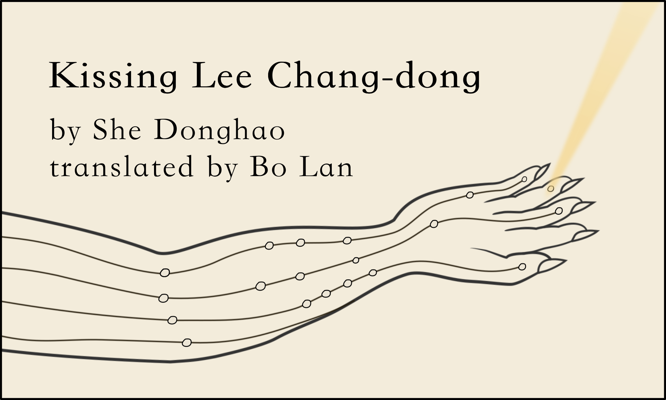
Cover illustration by Elizabeth Carney.
Comments
There are no comments yet.