


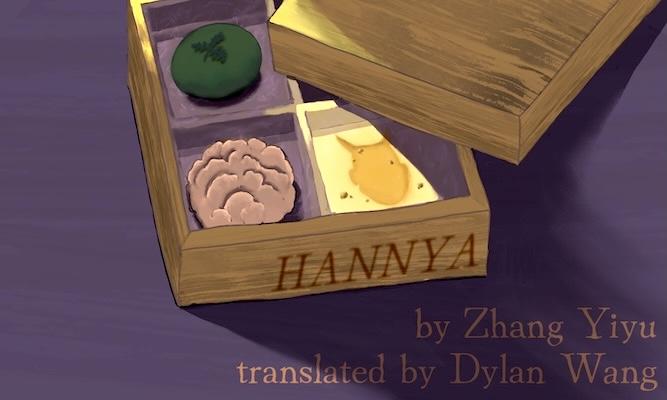
Hannya (excerpt)
By Zhang Yiyu
Translated by Dylan K. Wang
Synopsis: Set in West Berlin in 1974, at the height of the Cold War, Hannya unfolds through four intertwined perspectives, centring on two women: Seon-ja, a Korean immigrant, and Anna, a German scientist. As their stories and relationships gradually intersect, the novel explores the workings of memory – what is remembered, what is forgotten, and how the past persists in the present.
… when perception, as we understand it, is once admitted, memory must arise …
—Henri Bergson, Matter and Memory
(translated by Nancy Margaret Paul and W. Scott Palmer)
Then man says ‘I remember’ and envies the animal which immediately forgets and sees each moment really die, sink back into deep night extinguished for ever. In this way the animal lives unhistorically …
—Friedrich Nietzsche, On the Advantage and Disadvantage of History for Life
(translated by Peter Preuss)
Prologue: The Mask
West Berlin, 1974
‘Sin-mi’s home.’
Hearing the faint sound at the window, Seon-ja murmured the words to herself as she put the freshly made glutinous rice cakes into a paper box.
She knew that after school Sin-mi would never come through the front door. Instead, she would quietly make her way around to the back of the shop, where there was a tiny window known only to mother and daughter. Even the delivery men had no idea it was there.
She would slip effortlessly through the window, landing in the narrow aisle between two rows of shelves stacked with crocks of kimchi, sacks of rice, and large jars of cooking oil. The shelves were tall enough to hide the slight frame of a ten-year-old girl.
Seon-ja never worried about burglars. The window was so small that only a child or a cat could fit through it.
Stray cats did jump in from time to time and Sin-mi moved with the same weightless quiet.
But Seon-ja could always tell her daughter from a cat.
A cat landed with the hollow, fleeting sound of wind striking the mouth of a sack of rice. Sin-mi’s entrance was a long, whispering rustle, like fine white sugar sifting through a horsehair sieve onto a sheet of washi paper.
The confectionery shop stood in a residential enclave off Kiautschoustraße, in West Berlin’s Wedding district. To reach it, one had to leave the clamour of the main road, follow a cobbled lane beneath rows of flowering cherry trees, and walk several hundred metres before the little shop finally came into view.
Most of the neighbourhood’s residents were middle-class West Germans. A block away stood apartment buildings inhabited by immigrants from Northeast Asia, who formed the shop’s principal clientele. The signboard, painted in Korean, bore Sin-mi’s name. Germans couldn’t read it. They simply called the place Kirschenland – Cherry Land.
Four o’clock was when Sin-mi returned from school. It was also when Seon-ja’s second batch of rice cakes came out.
Glutinous rice was ground into flour and scalded with boiling water until it became soft and elastic, then coated in roasted soybean powder and ground sesame to make soybean rice cakes. The same glutinous rice dough, mixed with fresh mugwort juice, became fragrant mugwort rice cakes. White rice, finely milled into flour and steamed, yielded delicate white rice cakes, decorated with sesame seeds, walnuts, and other nuts.
Sin-mi liked the plain soybean rice cakes best.
Seon-ja only had to give her a small piece. The girl would hold it delicately between her fingers, sit on the doorstep, and nibble at it little by little, like a sparrow pecking at crumbs.
The cakes, arranged by colour in boxes lined with washi paper, rested on the cool countertop. Before long, customers would arrive one by one to buy them. Seon-ja always knew exactly how much to make each day. By her calculations, once she had worked out the month’s earnings, she would finally buy a refrigerator.
Sin-mi was painfully shy. Before the afternoon customers began to arrive, she would scurry upstairs.
The attic was her little kingdom. More than once, Seon-ja had reminded her to watch the stairs and mind the low ceiling, afraid she might fall. She had padded the foot of the staircase and installed a lamp because the light was dim, and Sin-mi was afraid of the dark. But then she found herself worrying that Sin-mi might break the glass lampshade and cut herself. In the end, none of her worries ever materialised.
Sin-mi had always been a careful child.
When she was three, Sin-mi wandered off once. Mercifully, she found her own way home.
After she started school, Sin-mi seemed lonely. Seon-ja suspected she hadn’t made any friends. Never once had she brought a classmate to the shop, and whenever Seon-ja caught sight of her on the street, she was alone.
Asian immigrants in West Berlin were scattered across the city. Those with money preferred to live in white neighbourhoods, while labourers tended to congregate in small pockets.
Even among Asian immigrants, there were distinct communities: prosperous Japanese businessmen based in West Berlin with their families; Chinese who ran unassuming Chinese restaurants; Vietnamese who owned nail salons.
Seon-ja herself had emigrated to Germany at the end of 1958. By then, the Korean peninsula was divided into North and South.
Today, Sin-mi was taking longer than usual to get home. Perhaps there was something on at school that had delayed her.
Instead, there came a sound from the front entrance. A truck had pulled up, but it wasn’t the supplier who usually delivered ingredients.
Seon-ja rinsed the soybean flour from her hands, dried them on her apron, and stepped outside. It was the postman. He was making his way up the flagstone path, carrying a battered cardboard box, tightly wrapped.
Seon-ja spoke hardly any German, and the postman said little. He simply pointed to where she should sign, then set the parcel down on the doorstep. As it landed, she heard the faint clink of pottery inside.
The parcel looked as though it had travelled across oceans. Rain had soaked through the wrapping, blurring most of the writing. It was addressed in Korean, but only the words ‘... Bereaved Families Association’ could still be made out. The return address was in the South.
Seon-ja fetched a pair of scissors, cut through the outer wrapping, and carried the parcel inside.
She set the parcel behind the worktable where she prepared the cakes, intending to examine it at her leisure. For reasons she couldn’t explain, she had a premonition that it should not be opened on the doorstep. There seemed to be something indefinably uncanny about the rain-soaked parcel.
Inside were layer upon layer of yellowed old newspapers. Wrapped within them were earthenware cups, saucers, and bowls, though some had shattered in transit. Seon-ja removed the broken shards with the utmost care.
At the very bottom lay a square wooden box, about the size of a ten-inch plate, bound with hemp cord. Alone among the contents, it had been packed with meticulous care. The lid even bore a small circular cherry blossom motif.
Seon-ja cut the cord, carefully eased up the brass clasp, and lifted the lid.
A breath of dust drifted towards her. Resting on a velvet cushion inside was a white Hannya mask.
A Hannya, one of the masks used in Japanese Noh theatre, depicts a woman transformed into a demon through consuming jealousy and resentment.
Ashen cheeks. Long horns. Blood-red, bulging eyes. Jagged black teeth. A mouth split wide. Where the pupils should have been were only two black holes. Fine cracks webbing its fleshy cheeks. The demon seemed at once to be laughing in madness and weeping in despair. A savage, malevolent presence emanated from the mask.
The instant Seon-ja saw it, her whole body stiffened. She almost dropped the wooden box.
A tide of memory surged towards her from thirty years ago, only to crash against an invisible wall, leaving behind a vast, hollow echo. She felt dizzy, as if the floor were giving way beneath her.
Then, a familiar sound came from the back window.
Sin-mi was home.
But the sound stopped. In the silence that followed, Seon-ja realised her mistake. It wasn’t Sin-mi.
It was the sound of wind catching the mouth of a sack of rice.
※
Chapter One
01. The Man Who Hunted Ducks
On the top floor of a seven-storey building on a side street off Friedrichstraße was the West Berlin Neuroscience Research Institute, where the Korean researcher Jeon Byeong-mun worked. His flat was only a short walk away.
Every morning, Byeong-mun drank a glass of cold milk before leaving for work.
Outside, he pulled his trench coat tightly around himself, turned the collar high against his jaw, and hurried silently past the long brick wall topped with barbed wire. More than a decade had passed since the Wall had gone up, yet demonstrations were still held there from time to time, protesting the policies of Walter Ulbricht and Erich Honecker, as well as Soviet control over German sovereignty.
None of it concerned him. All he cared about was not being late.
The Germans prized punctuality. As the only Asian face at the institute, Byeong-mun wanted nothing more than to do his work well and avoid being singled out. He was tired of complicated human relationships.
He approached the glass doors and headed for the time clock mounted on the wall to their right. With practised ease, he inserted the magnetic card bearing the institute’s insignia and clocked in.
‘Guten Tag.’
The security guard in the gatehouse looked up from his newspaper with a smile. Byeong-mun summoned up a smile of his own and returned the greeting.
Following the long flight of concrete steps, he reached the laboratory wing, where several test subjects were already waiting. Byeong-mun shot them a brief glance. The men were unshaven. Some had bloodshot eyes. Some had grey-blue varicose veins bulging on the backs of their hands. Others had crumbs of pretzel bread caught in their beards.
He had grown accustomed to his eyes working like a camera, automatically capturing every scrap of information from whatever lay before him.
The homeless men glanced up at Byeong-mun, then turned away again with the same lifeless expressions.
To them, this man from the Orient was probably nothing more than a cleaner employed by the institute.
Byeong-mun nodded a greeting before entering the laboratory. He hung his trench coat on the rack and took out his notebook.
He wondered if they might be a little surprised when their names were called and they found that the slight Asian man before them was the one conducting their tests.
Byeong-mun opened a large ring binder and skimmed the previous day’s clinical notes. Then he took out his fountain pen and some manuscript paper and began writing his experimental report.
After writing for a while, he remembered a paper he had read some time ago that might be useful. He went over to the filing cabinet and took out the folder where he kept his notes and excerpts from the literature. Returning to his desk, he set the thick bundle before him and began leafing through it.
A buff-coloured document envelope slipped out from beneath the folder and fell to the floor. He bent to pick it up, but his gaze froze when he saw the words typed across it:
Vessels of Memory (Kioku no utsuwa):
A Study of the Specific Substrates of Human Memory
Authors: Jeon Byeong-mun, Anna Müller
First published: 22 September 1960
It was a research paper he had written in English years ago. The experiment, however, had never gone any further. He had no memory of leaving the paper here. It should have been gathering dust in one of the document boxes he had packed away after graduation.
And the name printed after his own…
The laboratory door clicked open. Anna Müller, the paper’s second author, walked in.
She wore a dark blue silk blouse and black tailored trousers, like an arc of electricity. A bitter wind swept in from the corridor, billowing the front of her blouse. Her cheeks were lean, her gaze sharp, and she wore lipstick in open disregard of laboratory regulations. Her hair was a dazzling gold, yet there was something almost metallic in the fervour of her grey-blue eyes. Looking at her, Byeong-mun would always remember how their colleagues in the laboratory described her: an academic machine from the old Empire. But even that could not obscure her beauty – a beauty at once aggressive and intellectual.
She held master’s degrees in neuroscience and psychology from the Freie Universität Berlin, after completing her undergraduate degree in law at the Ludwig-Maximilians-Universität München. These days, she was only an occasional presence in the laboratory.
Most of her time was spent serving as a legal adviser in post-war litigation.
Today was different. A new round of testing was about to begin for her project on ‘retrospective memory.’
Byeong-mun did not know what she made of him. Certainly, he was a good laboratory partner, a foreign secretary and assistant who was always silent and obedient, and, on some lonely, rainy nights, her lover.
Anna glanced at the paper lying beside him. ‘You’re still working on this?’ she asked casually.
Her German carried a faint trace of a Bavarian accent.
‘No. I was looking for something else.’ Byeong-mun quickly put the paper away.
‘Anna, your subjects are here.’
‘Could you keep the records again today?’
‘Of course.’
Anna’s current research on ‘retrospective memory’ was a highly focused phase of experimentation undertaken for her Habilitation, the German postdoctoral qualification, and comprised several different types of test.
Until then, Anna had mainly assigned Byeong-mun story-retelling experiments, modelled on the British psychologist Frederic Bartlett’s research into the unreliability of human memory. Drawing on his theory, Anna devised an experimental procedure: Byeong-mun would select folktales unfamiliar to Westerners and tell them to the subjects. After a few minutes, the subjects would be asked to retell the stories in their own words. Their retellings would then be compared with the original texts to determine the extent to which memory reshaped the act of narration.
Byeong-mun spent two days holed up in the library, looking for Japanese fables, then selected a handful he thought sufficiently obscure, full of images and plot elements unfamiliar to the locals.
Anna had made the purpose clear: the experimental material was to be ‘defamiliarised’ as much as possible, so that the subjects’ pre-existing memories would not interfere with the results.
Almost every retelling involved some degree of reworking. The subjects either smoothed out the logic or replaced unfamiliar elements in the stories with things they knew. The Japanese raccoon dog (Tanuki-Katze), for instance, would often become a cat (Katze), a wildcat (Wildkatze), or even a hare (Hase) in the retelling.
But the little retelling game was only an insignificant part of the larger programme. Another experiment, one that consumed far more of Anna’s time, was known as the ‘core memory’ experiment.
Anna selected the subjects for these sessions herself; it was not Byeong-mun’s place to interfere. She conducted every session personally, while his role was limited to registering the subjects and organising the research materials.
During the experiment, Anna would give each subject a series of keywords and ask them to recall, as fully as possible, particular moments from their lives. She would then probe deeper and press them to provide every detail of the scene they could possibly remember.
The process demanded enormous mental stamina from both sides.
By the end of each session, even Byeong-mun, who did nothing but take notes, would be drenched in sweat, his mind completely blank. Anna, on the other hand, would emerge as though nothing had happened.
Byeong-mun had urged her more than once to recruit from universities, or at least from among the better educated, but she always refused. Instead, she sought out homeless people and elderly people living alone, gave them her card, and told them when to come. She paid them out of her own pocket, at rates higher than those set by the institute. Every subject was carefully chosen.
To Anna, these were the ideal subjects. As she put it, ‘They have plenty of time. So much of it that all they can do is remember.’
But being made to remember was not the cruellest part.
Each time he sat through one of these sessions, Byeong-mun came away with a heavier heart. Anna would relentlessly question the truth of every detail her subjects recalled, interrogating them almost as a police officer might interrogate a suspect. She seemed to possess an uncanny instinct for knowing exactly when someone was lying – when a memory had been deliberately distorted or something was being concealed. She would keep pressing until, backed into a corner, they changed their story and admitted that they had remembered it wrong.
Byeong-mun still remembered one such occasion. It had happened a little over six months ago. The subject was an elderly widower named Wolf.
During the session, at Anna’s prompting, the old man recalled his son, who had enlisted and fought on the Eastern Front.
‘December 1938. I took my son out hunting wild ducks in the fir woods. The frost and fog were so thick we could hardly see the way. My son said, “Papa, perhaps we should go back. There aren’t any garganeys here.” But I told him, “There will be. Just up ahead.” And then all these garganeys rose out of the fog...’
‘Mr Wolf,’ Anna interrupted. ‘I’m sorry, but that’s impossible. You lived in the north. The migratory ducks would already have left by then.’
‘Yes, yes. They were tufted ducks. Forgive me, Miss Müller – you see what my memory is like. I said, “Now, son!” And then he fired. What a shot it was. The duck’s blood turned the lake red...’
‘The lake?’ Anna asked at once. ‘There was still open water? It hadn’t frozen over?’
‘Yes, the lake. There were just a few patches of floating ice,’ old Mr Wolf muttered with a frown, though he no longer sounded certain himself.
‘Please try to remember again. This is important.’
‘I can’t remember clearly... Perhaps the lake was frozen. But I remember the feathers were wet when we brought the bird back.’
‘Then perhaps the duck landed among the reeds rather than on the lake. There would have been tiny crystals of ice on the grass, and when they melted, they would have dampened its feathers.’
‘You’re right... It was the reeds.’ The old man looked bewildered.
‘If it died instantly, the bullet should have struck it in the neck.’ Anna gestured towards her own throat. ‘But when we spoke before, you said that Hans was never a particularly good shot. The chances of him bringing it down with a single shot would have been quite low. Perhaps you shot it yourself, or perhaps you fired the finishing shot.’
‘No. It was Hans who shot it!’ Unexpectedly, the old man was adamant this time.
‘My apologies, Mr Wolf. I only wanted to make sure. Please, go on,’ Anna said, though there was not the slightest trace of apology in her expression.
‘He ran over first, and I followed more slowly. I saw him standing with his back to me. I said, “Well done, son. We can stew it for dinner tonight.” When I came around to face him, I saw him cradling the dead duck in his arms, stroking its bloodied feathers. Then Hans looked up at me and said...’
‘Said what?’
‘I’m sorry. I don’t think I remember it very clearly.’
‘But you do.’
The old man lowered his head. Just as Byeong-mun thought he might give up on the memory altogether, he looked up again and continued.
‘He said, “Papa, it wanted to live so badly.”’
Byeong-mun was taken aback. For a fleeting moment, something in the old man’s expression reminded him of his own father.
Even though, in every other respect, his father had nothing in common with the man sitting before him.
‘So the duck wasn’t quite dead yet.’
Anna paid no attention to the sadness in the old man’s words. She delivered the conclusion matter-of-factly.
‘Possibly. But I didn’t notice. I was too busy praising Hans...’
A brief silence followed. Anna cleared her throat and leafed through the file in front of her.
‘Allow me to correct one thing, Mr Wolf. Your son was afraid to fire a gun. That was why you took him hunting in the depths of winter – you wanted to toughen him up, didn’t you? You both fired at the same time, but he deliberately aimed wide... It was you who brought down the duck. You knew that, too. You simply wanted him to believe it was his kill.’ Her voice was calm, but left no room for contradiction.
‘I read it in Hans’s diary,’ she said, taking a notebook from the file and handing it to him. It had been sealed in a plastic sleeve and marked with an archival label. The diary had been recovered after the war from among the personal effects of an accused war criminal.
Old Mr Wolf stared at Anna, trembling as though he were looking at the devil himself. He leafed through the diary. Written there in fountain pen were the words:’ 26 December 1938... I deliberately aimed wide, but the duck died anyway.’
The old man collapsed back into his chair.
Behind the darkened glass, Byeong-mun recorded everything that happened. Anna insisted on it: no detail was too small. Every movement, every response, had to be there in black and white. She never trusted anything committed to human memory. Old Mr Wolf was only one of many subjects.
When they left the institute, some would emerge dazed and disoriented, some would even break down sobbing in the street.
That was how ‘Anna’s experiment room’ earned its notoriety.
That day, as Byeong-mun watched through the floor-to-ceiling window as the old man shuffled out of the building like a walking corpse, Anna stood silently beside him and lit a cigarette.
Byeong-mun could no longer be bothered to remind her that smoking was forbidden inside the institute. Instead, he silently found her a shallow saucer to use as an ashtray. Anna tapped her cigarette against its rim, and a drift of white ash fell soundlessly into it.
‘Why were you so determined to prove that Mr Wolf was lying?’ Byeong-mun asked.
Anna smoked in silence.
After a while, she said evenly, ‘His son wasn’t in the Wehrmacht. He was in the SS. He was sentenced to hang after the war. I’ve read the military tribunal records. He admitted to personally executing seventy-six people, most of them prisoners of war and civilians from the occupied territories who had strayed into restricted military zones.’
Byeong-mun had nothing to say.
From then on, he ceased passing moral judgement on Anna, even in the privacy of his own thoughts.
He understood perfectly well what she was trying to do: why she challenged her subjects’ accounts so relentlessly, interrogating every detail and even using leading questions to steer their recollections in different directions.
Her research into retrospective memory was concerned precisely with the extent to which memory could be embellished and reshaped. Time and again, the evidence showed that even when confronted with ‘core memories’ bound up with family and emotion, subjects would involuntarily distort the truth – whether to cast themselves in a better light or to conceal something shameful.
Subjective accounts always hovered somewhere between fact and fiction, making the truth itself difficult to verify. That was why Anna devoted so much time to tracking down corroborating evidence before selectively approaching potential subjects.
Anna was well connected throughout West Berlin and could easily gain access to all manner of archival records. She was also remarkably efficient. In the years they had worked together at the institute, Byeong-mun had watched her tirelessly devise one experimental programme after another.
Another round of testing came to an end. Byeong-mun put away the clinical notes and went out to shake hands with each of the six homeless men, duly receiving the surprised looks he had expected.
None of them emerged shattered today. Some even seemed relieved.
Byeong-mun returned to the laboratory and found Anna sitting alone with a book. He could tell that she was deeply dissatisfied. She had not found what she was looking for in any of those stories.
‘I’ll sort out the notes,’ Byeong-mun said.
Anna nodded.
‘Wait, Jeon.’
As though something had suddenly occurred to her, Anna looked up. ‘Are you free this evening? A few colleagues from IBRO are visiting from Zurich. We’re having dinner together. I’d like you to join us.’
‘Jawohl, Chief.’
Byeong-mun deliberately mimicked the tone of a subordinate addressing a superior officer.
Anna laughed. She liked this Asian man. He seemed solemn and reserved, yet every now and then he would come out with a perfectly timed piece of dry humour.
※
An Italian restaurant near the institute.
Outside, a fine night rain was falling. For the scholars from the International Brain Research Organization who had travelled so far, a steaming plate of tomato-and-basil pasta with black olives was comforting after the weariness of the journey.
Byeong-mun found himself getting along well with them. He also learned that, six months from now, a cognitive science symposium bringing together specialists from across Europe would be held in Zurich, the Swiss capital. The subject was closely related to his own research interests. Anna suggested that they attend together.
They talked about all sorts of things: their respective fields, philosophy, and eventually international affairs – the development of the European Community, the Vietnam War, post-imperialist colonial policy, cooperation and disagreements with East Germany, and much else besides.
Everyone around the table had their own views, and many held politically progressive opinions. There was something refreshing about talking with them. Even so, Byeong-mun was careful to keep some of his own thoughts to himself.
Professional gatherings like this always left him mentally exhausted. His attention drifted, and he found himself longing for his late nights alone in the laboratory.
Anna suddenly gave him a gentle nudge. To all appearances, she was still smiling and chatting with the other scholars, but a slight movement at the corner of her left eye told Byeong-mun that she wanted him to look outside.
Following her cue, he turned his gaze towards the window and saw a solitary figure standing across the street.
Byeong-mun’s whole body went rigid.
He had never been good at hiding his reactions. It was not long before the others at the table noticed where he was staring and followed his gaze. Across the street stood a slight Asian woman, all alone.
Seon-ja.
She looked like a wandering ghost with no one to claim her. It was seven years since they had last seen each other. Byeong-mun could not imagine what could have brought her here now. She looked utterly lost. But there was no question that she had recognised him.
They were seated by the window on the ground floor. Across the glass, the restaurant’s signature dishes had been painted in colourful italic lettering, the sort of gaudy decor Italian restaurants seemed to favour.
Seon-ja appeared to have spotted Byeong-mun through the curling bands of colour, but she made no attempt to disturb him.
She simply waited. She had always been good at waiting. She never hurried anyone. Throughout her brief marriage to Byeong-mun, Seon-ja had always been the one who waited rather than pursued. If human patience could be measured, Seon-ja’s would have surpassed that of anyone else he knew.
Yoon Seon-ja stood there, her eyes fixed on them. The scholars were visibly uneasy now, and one by one their eyes turned to Jeon Byeong-mun – curious, concerned, puzzled, speculative.
He was the only Asian at the table. In that moment, the racial difference they had all deliberately ignored suddenly asserted itself. At last, Byeong-mun made up his mind. He rose and gave a slight bow.
‘Excuse me. I think she’s here to see me.’
Byeong-mun took his trench coat from the waiter and quickly pulled it on before heading out of the restaurant.
Turning up his collar, he dashed across the street, his leather shoes striking puddles and kicking up muddy water that spattered the hem of his coat.
He hurried towards Seon-ja, but she did not move. She simply stood there in silence, exactly as before.
※
He was soon standing before her and greeted her in Korean, though their mother tongue sounded strangely foreign to him now.
‘Seon-ja-ya, what is it?’
Byeong-mun deliberately softened his voice, using the intimate Korean form of address. Anyone could see that something was terribly wrong with Seon-ja. Slowly, she raised her eyes to him, and only then did Byeong-mun see that her face was white as paper. Her lips were trembling. She looked as though she might collapse in the rain at any moment.
Without thinking much further, and no longer caring about the curious eyes that might be watching from behind the window, Byeong-mun opened his arms and embraced her, letting her draw what strength she could from him. His trench coat rustled against her jacket as the fine rain drifted through the straight cones of lamplight and fell upon them.
Then Byeong-mun noticed the grey in Seon-ja’s hair.
Fine silver threads had begun to appear at the roots. The discovery startled him. In his mind, Seon-ja had always remained a young woman in her early twenties, a wintergreen growing at the foot of Mount Paektu. He often forgot that she was nearing forty now, and that she had spent all these years working hard.
‘Sin-mi’s father.’ Seon-ja finally spoke. Her breathing was quick, and the sob in her voice seemed on the verge of breaking through. ‘Sin-mi... Sin-mi is gone.’
Thunder.
Lightning tore across the clouds.
Jeon Byeong-mun felt that fate had finally come for him.
Vessels of Memory. Vessels of Memory. Vessels of Memory.
※
02. The Caged Bird
The setting sun glowed gold and crimson, its light glazing the torn wisps of cloud, like billows of cotton candy dusted with caramel crystals.
Seon-ja sat on a bench, her eyes fixed on the gates of Wedding-Grundschule.
It was the end of the school day. Children emerged one after another, schoolbags on their backs, and left hand in hand with their parents or nannies.
How she wished that, in just a few more seconds, Sin-mi would appear among them, then nestle against her as they made their way back to the confectionery shop together. She waited for that moment until dusk.
But what she saw before her confirmed it: Sin-mi had never come out of the school.
Seon-ja bit her lower lip and stared at the ornate iron gates until the school guard cheerfully bade farewell to the last group of children and swung them shut. She had no choice but to get up and leave, walking as though her feet scarcely touched the ground.
※
Half past eight in the evening.
From a public phone box, Seon-ja dialled the number of the institute office from memory.
Thank goodness. In thirteen years, the number had never changed.
Byeong-mun was working late when the call came. Assuming it was about work, he picked up.
‘Hello, Institute of Neuroscience.’
‘Have you found Sin-mi?’ Seon-ja asked.
At the sound of her voice, his whole body stiffened.
Byeong-mun tightened his grip on the receiver.
‘No.’
‘Did you go to the school?’
‘Yes. I spoke to Sin-mi’s teachers. They said she hadn’t been in today,’ he replied without hesitation.
No. He was lying.
Seon-ja had spent the whole day at the school. Byeong-mun had never shown up.
‘…’
Her silence spoke her anger.
‘…’
Don’t ask any more questions, Seon-ja. Sin-mi isn’t coming back.
Byeong-mun screamed the words silently to himself.
‘Maybe she’s gone off somewhere with her classmates. She might be back in a day or two. She has her travel pass. She could have gone anywhere out in the suburbs … It’s spring. The wildflowers are all in bloom.’
The words came out in fits and starts.
Seon-ja remained silent.
Sin-mi had no friends. Her mother was her entire world. Byeong-mun could only say such a thing because he had been absent from Sin-mi’s life for seven years – long enough to know almost nothing about the person his daughter had become.
But there was no point exposing his lie now. Finding Sin-mi was all that mattered.
Once again, Seon-ja held her tongue. She said nothing about the strange Japanese mask she had received that morning. It might have been a warning from whoever had abducted Sin-mi, but Seon-ja could think of no one she had ever wronged.
Bringing it up now might only throw Byeong-mun and the police off track.
‘Please, call the police for me,’ she pleaded.
‘All right. Leave it to me,’ Byeong-mun replied at once.
‘Where are you? We can go to the police station together.’
‘I’m at the office. I … I’ll report it later. You go back to the shop and get some rest. I’ll let you know the moment I hear anything.’
Seon-ja raised her face and silently looked up at the seventh floor of the institute. The light was on in Byeong-mun’s office.
‘Seon-ja?’
When there was no answer, Byeong-mun called her name again, uneasily.
Then he heard her hang up.
※
A street in Wedding, West Berlin.
Outside the police station, two stocky officers stood chatting and sipping thick, frothy black coffee from plastic cups. Among those waiting to make a report were drunks, homeless people, and housewives seeking refuge from domestic violence. Everyone seemed to be shouting, adding to the noise and agitation of an already restless, chaotic night. But this was only a tiny cross-section of Berlin’s nightly crime.
Seon-ja had been lingering outside for three hours, unable to summon the courage to go in.
Her spoken German was poor; she knew only a few simple words. Over the years she had lived in West Berlin, she had grown used to avoiding conversation with the locals. There was little need for it anyway. The prices and quantities of everything in the shop were written on a blackboard. There was a calculator on the counter, and she kept slips of paper ready with cooking instructions. She could get through a day’s work without having to say much at all. Back in East Germany, her lack of German had caused her no end of trouble. When it came to languages, she seemed to have a natural block.
And now there was no way she could explain something so complicated: a nine-year-old Korean girl had disappeared, and someone had sent her mother a mask of a Japanese demon.
‘Madam, is there something we can help you with?’
A policewoman had noticed her and, finally unable to ignore her any longer, came down the steps and walked towards her. The policemen who had been chatting glanced over as well. Their attention only made Seon-ja more tense.
Like a startled quail, she shrank into herself.
‘Hey, I know you! You’re the lady who runs that Chinese confectionery shop on Kiautschoustraße, aren’t you? My wife loves your cakes.’
One of the policemen suddenly came over, delighted to recognise her, gesturing awkwardly as he spoke.
Unfortunately, Seon-ja understood none of what he was saying. The German policeman’s sudden booming voice had almost frightened her out of her wits. In a panic, she pulled her shawl tightly around herself, turned and hurried away in small, quick steps, ignoring the voices calling after her.
※
Back at the shop, Seon-ja sank down exhausted in the entryway and for a long while could not bring herself to her feet.
A single tear slipped from the corner of her eye.
The lights in the shop were dim. The shoe cabinet was empty. Everything was as it had been. Sin-mi had not come home on her own.
Kagome, kagome, the bird in the cage,
when, oh when, will it come out?
The old song seemed to sound again in her ears. Years ago, whenever Sin-mi could not sleep, Seon-ja would sing it to her, gently patting her tiny body.
It was actually a Japanese children’s song, but Seon-ja knew every syllable by heart.
Sin-mi had soon learned it too, awkward Japanese pronunciation and all. Sometimes she would hum it to herself around the shop.
Now Seon-ja climbed the stairs to the attic, humming the song in a daze.
In the night before the dawn,
the crane and turtle slipped and fell.
Who is standing right behind you?
As she reached the last line, there came a sudden crash from downstairs – a bottle falling to the floor.
Who is standing right behind you?
Seon-ja spun around, switched on the light, and hurried downstairs. At the last step, her cotton stocking snagged on a splinter, catching her foot. Her shin struck the edge of the stair and she fell heavily to the floor.
Pain shot through every nerve. She could already tell it would leave a nasty bruise.
But there was no time to tend to the pain. She struggled to her feet and limped towards the source of the sound.
There was no one there.
Only moonlight, cold as water, spilled through the window onto the empty floor beside the last row of shelves. At one corner, a floorboard had buckled upwards.
There was a compartment beneath the floor where she kept things of importance.
The box containing the Hannya mask was there now. Seon-ja had placed it inside a wooden chest normally used to store ingredients for the rice cakes.
She took a deep breath and tried several times to steel herself, but still could not bring herself to open the compartment.
Every time she saw the mask, a sickening sense of dampness and decay churned in her chest and rose into her throat.
She knew that she had forgotten something important.
And she believed that whatever she had forgotten was connected to Sin-mi’s disappearance.
Byeong-mun had been evasive on the telephone, leaving her with the suspicion that he had somehow known this was coming. There had even been something in the way he responded to her that seemed less like concern for Sin-mi than relief. Could Sin-mi’s disappearance have something to do with him? Seon-ja had never wanted to suspect Byeong-mun. They had been separated for seven years, but apart from Sin-mi, he was still the only family she had in all of West Berlin.
But her thoughts were in such disarray that she could not make herself do anything useful.
Overcome by bewilderment, Seon-ja curled up on the floor, knees clasped to her chest, like an infant suspended in the womb. She felt that if she let go, she would collapse from within.
And like that, she fell asleep.
※
03. Phantom Memories
The Siberian wind...
Irkutsk, Soviet Union, 1953.
The wind, laden with grains of snow, lashed endlessly against her face, as though it meant to slice through her pale skin.
Seon-ja sat in an open-air market in Eastern Siberia, wrapped in a padded coat far too large for her, shivering uncontrollably from the cold.
After the outbreak of the 6.25 War, as North Koreans called the Korean War, Seon-ja fled with many others from her village, only to become separated from her family along the way. Terrified of the fighting to the south, the refugees headed north, crossing the Duman River and eventually passing into the Soviet Union.
As a fellow communist state, the Soviet Union took them in. But as refugees in a foreign land, their fate was no longer in their own hands. They were transported away in batches, and Seon-ja was eventually resettled in the principal city of Eastern Siberia.
A small community of Korean immigrants lived there, descendants of those who had fled the peninsula following the Japanese colonisation of Korea and eventually made their way to the area. In the 1930s, many had been forcibly deported to Central Asia on Stalin’s orders, but after his death, as the political climate eased, they began to trickle back. They had by then assimilated into the local community and spoke only Russian, having all but lost their Korean. Seon-ja could find no one there she could talk to.
For the time being, she worked as a helper for a woman who sold kimchi. Though they could barely understand each other, the woman had taken her in because they were fellow Koreans. There were no wages, only meals.
Although already an adult, Seon-ja was so slight that she looked no more than thirteen or fourteen. Each day, she would hoist tubs of kimchi far heavier than herself onto her back and trudge all the way from where they lived to the market.
After a day’s selling, she would return home to a bowl of coarse brown rice flecked with husks and grit, sometimes accompanied by a thin beef broth.
All around her in the market, people murmured among themselves. Since arriving, Seon-ja had picked up a little Russian, and her ears caught two words amid their conversations: ‘Japan’ and ‘prisoners-of-war.’
There was a prisoner-of-war camp nearby, holding former soldiers of the Japanese Kwantung Army captured in Manchukuo after Operation August Storm. They were put to forced labour in the surrounding area.
From the women’s gossip at the market, Seon-ja gathered that septicaemia had recently become widespread in the camp, and that some of the prisoners might come to buy provisions.
Seon-ja waited anxiously beside the tubs of kimchi. Sure enough, around noon, several Japanese prisoners appeared. Their faces had a sickly grey-green cast. Dressed in padded prison uniforms, they were small and stooped, their eyes seemingly emptied of hope. Armed guards followed close behind.
One of the prisoners approached her stall, a Soviet guard following behind him with an impatient look on his face.
‘T-two bowls,’ the Japanese man said in halting Russian. Trembling, Seon-ja opened the kimchi tub and reached in with a wooden ladle for the pickled cabbage, speckled all over with chilli seeds. She could see an almost desperate hunger in the prisoner’s eyes as he stared fixedly at the cabbage. It was the source of vitamins they had been longing for. But under that gaze, the strength seemed to drain from her hands. Her wrist trembled, and the heavy folds of cabbage kept slipping from the ladle.
Perhaps she was taking too long. The guard barked at her to hurry. The Japanese man grew increasingly desperate. His hand trembling, he reached towards her, apparently intending to take hold of her wrist and help her ladle the kimchi into the wooden bowl.
Ignoring the guard’s shout, his claw-like hand touched Seon-ja’s skin.
Bang!
The wooden ladle fell onto the slushy ground.
Seon-ja’s eyes widened. She stumbled backwards, then turned and fled from the market.
※
She kept running, falling and scrambling back to her feet again and again, as though the moment she stopped, a ghost would catch her.
Ahead of her was a line of fencing with a gap torn through it. She squeezed through.
Snow and sleet swirled all around her, obscuring the way. She had already crossed Kirov Street in the centre of the city. She had lost all sense of direction now and could no longer find her way back to the market.
Something hard pressed painfully against the soles of her feet. She looked down and saw rows of wooden beams beneath her.
Railway sleepers.
Seon-ja followed the tracks. Ahead, she saw a steam train, carriage after carriage loaded with logs, while soldiers directed the transport operation nearby.
The train began to move.
One of the soldiers noticed Seon-ja approaching and started in alarm. He shouted something in Russian and ran over to grab her. Amid the howl of the wind, all Seon-ja could see clearly was the gleaming red star on his cap. Holding her with his left hand, the soldier flung his right arm repeatedly behind him, signalling frantically for her to move back, away from the train that was about to depart. A short distance away, several other servicemen noticed something was wrong and began running towards them.
The Red Army soldier was wearing gloves, but even his touch sent a shudder through Seon-ja’s whole body. Again she saw the skeletal hand of the Japanese prisoner reaching towards her.
Summoning strength from somewhere she did not know she had, she tore herself free of the soldier’s grip and ran towards the moving train.
Shouts rang out behind her, followed by the metallic snap of a rifle bolt.
Seon-ja kept running for her life. Luckily, the Soviet soldiers did not fire. In the few moments they hesitated over whether to shoot, she managed to catch up with the last wagon.
The train thundered onwards like a steel beast at full gallop. The closer she came, the more violently the wind tore at her. She reached out and seized the handrail. Her bare skin seemed to fuse to the frozen metal as though it were red-hot; she felt as if the skin of her palm were being ripped clean away.
The instant she hauled herself aboard, the momentum sent her crashing face-first onto the floor. Her mouth filled at once with the taste of blood, and a violent pain shot through her lower leg.
Then, as an icy numbness closed in on her from all sides, she lost consciousness.
※
- The confectionery shop in West Berlin.
Seon-ja woke.
The sensations of the dream were still vivid. With startling clarity, she understood: this was no nightmare invented by her mind. It was her past.
Yes. She had been to Russia – to the snowfields of Siberia, long before she found herself in West Germany.
Until this dream, Seon-ja had not realised that she had forgotten that part of her life.
Ever since the mask arrived, a valve in her memory seemed to have opened. Fragments of a past long since faded were returning to her, one by one, fitting themselves into the gaps in her memory.
—End of excerpt—
Cover illustration by Hal Y. Zhang.
Comments
There are no comments yet.