
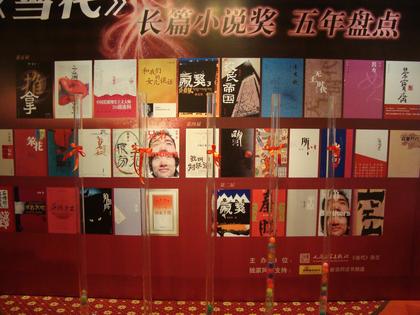
This morning was the press conference for the Dangdai literary magazine's fifth annual best novel award. Dangdai, which is run by the People's Literature Publishing House, is trying to turn this prize into a bit of a challenge to the hegemony of the bigger prizes administered by the Writers Association: the editor of Dangdai, Yang Xinlan, specifically touted this prize as the non-governmental answer to the Mao Dun prize.
Every literary prize and its brother is touting "transparency" and "fairness" these days, but the Dangdai prize might get a little closer to that goal than most: there is no cash for the winner, reducing some of the incentive for backdoor dealing, and to hear Yang talk, the judges were left unmolested during the nomination process. She even described them as being slightly taken aback when the magazine had no "directives" or even gentle hints as to which direction they should cast their votes — if this is true, it speaks as well for the Dangdai prize as it does poorly for the other prizes.
There were two parts to today's event, which was attended mostly by publishers and literary magazine type folks: 2008's best novel award, and also a sort of grand prize given to one of the winners from the past five years. The panel of judges was as follows:
- Bai Ye (白烨)
- Li Jingze (李敬泽)
- Chen Xiaoming (陈晓明)
- Meng Fanhua (孟繁华)
- Zhang Yiwu (张颐武)
- Yan Jingming (阎晶明)
- Lei Da (雷达)
And the 2008 winners (the readers pick came mostly from voting on Sina.com):
- Judge's Pick: Bi Feiyu's Tuina (推拿)
- Reader's Pick: Yang Zhizhun's Tibetan Mastiff 3 (藏獒3)
The results of the five-year grand prize (voted on, oddly enough, by those who happened to be present in the room at the time — I very nearly voted myself) were a resounding win for Wang Gang's Yinggelishi (英格力士), the English translation of which is coming out in spring of 2009.
Update: I don't know how I messed that up: it was actually Yan Geling's Xiao yi duo he (小姨多鹤) that won in an elimination-round upset, as is clearly indicated by the ping-pong balls in the tubes in the photo above. Thanks to zhwj, who was also present and apparently awake, for the correction.
Update 2: That night I ended up at dinner with someone from the Writers Press (作家出版社) and listened to a long litany of complaint about this prize: the magazine belongs to the People's Literature Publishing House, and apparently they stacked the voting deck by inviting a small army of their own editors, but only one or two from other publishing houses (for instance, the Writers Press). She was highly dismissive of the prize, and regardless of how much of that was sour grapes, it still cast a shadow on the whole thing…
An unrelated but amusing anecdote from the same editor: she had just returned from a meeting in Guangdong arranged by the provincial-level Writers Association. Apparently the Writers Association in Guangdong has an impressive budget which they'd failed to expend before year's end, and so they invited writers and editors from all over the country to visit Guangdong for a couple of days, eat expensive food, and "have a meeting". Attendance came with a 10,000 rmb thank-you prize. "It was very boring", she said.
Comments
The PLP may have stacked the deck, but Writers Press won the voting - they're the publisher of Yan Geling's book, which beat out PLP's English. Perhaps they bought off the jury, which awarded the grand prize to PLP's Tuina...
jdmartinsen, February 26, 2009, 1:53a.m.
Link to their site is dead. I'm trying to find a link to the PLPs translations of English fiction in conjunction with the British Council. Making no headway, any constructive suggestions most appreciated
Jason Kennedy, February 18, 2010, 3p.m.
Honestly can't follow this.
Is the list of contenders for 2010 award listed above or anywhere else?
When will the award for 2010 be made?
Bruce Humes, February 19, 2010, 12:31a.m.
Jason, the below seems to be what you're talking about, from this link.
Thanks for the head's up on the PLP's dead website link, unfortunately that does seem to be their only website. I guess everyone's gone home over the holidays.
英国大使馆文化教育处致力于推广来自英国的、极具创意的当代作品,并通过英国文化协会(在中国作为英国使/领馆文化教育处运作)的全球网络,吸引国际文学读者;并通过与世界各地的数百名作家携手,和颇有影响力的合作伙伴,英国文化协会共引导350多个文学项目,并发表了众多文学作品。
《新英语 新写作》英汉对照系列就是最新由英国大使馆文化教育处和人民文学出版社合作出版的英国当代文学精品集。该系列包含四本书,从英国当代最优秀文学作品选集《New Writing》中选译了2004-2007年度的34篇作品出版。作品涉及长篇小说、诗歌、散文和短篇小说等多种体裁, 书名分别为《奶》、《一小窝弄学人》、《彼德•卡恩的第三个妻子》和《爸爸的秘密生活》。所收录的作家既有英国各类文学奖项的得主,如获得苏格兰艺术委员会年度小说奖的克斯蒂•甘(Kirsty Gunn)、获得T S Eliot 诗歌奖的唐.帕特森(Don Paterson)等,也有文学界的新声音Selma Dabbagh 和 Zoe Strachan等。
Eric Abrahamsen, February 19, 2010, 1a.m.
Thank you, Eric, that link is the best description of the program that I've seen.
So, I found the collection, 'Secret life of Dad', and they included one of my stories. I can now have my friends in Taiwan check it out.
Best
Jason, February 19, 2010, 1:14a.m.
Glad to help. I just realized it would have been politer to translate the pertinent info, but that doesn't seem to have posed a problem!
Eric Abrahamsen, February 19, 2010, 1:39a.m.
Google Translator!
Jason, February 19, 2010, 1:40a.m.