
Han Dong (1961 – ) 韩东

wikipedia | MCLC | MyChineseBooks.com | Chinese Short Stories |
photo courtesy of Tineke de Lange
Han Dong began writing in 1980, and has been a major player on the modern Chinese literary scene since the 1990s. He is well-known as one of China’s most important avant-garde poets, and is also an established essayist, short story writer and novelist.
Born 17 May, 1961 in Nanjing. Han Dong’s parents were banished to the countryside during the Cultural Revolution, taking him with them. When the Cultural Revolution ended, he studied philosophy at Shandong University, graduating in 1982. He subsequently taught in Xi’an and Nanjing, finally relinquishing teaching in 1993 and going free-lance as a writer.
In October 2017, his first film "One Night on the Wharf", adapted from his novella 《在码头》/One Night on the Wharf, had its debut at the Busan International Film Festival. Han directed, the producer was Jia Zhangke. Variety review is here and there are more pictures of the screening on Weixin/WeChat. For the link to the translation of this story, see below.
Fiction in English translation:
The novella One Night on the Wharf, translated by Nicky Harman, was published in 2022 in a Read Paper Republic series, Figures in a Landscape, where it can be read free and in full.
A novella, A Tabby Cat's Tale, was published by Frisch and Co in 2016, and the translator's Translation Notes are at Necessary Fiction
December 2012 Ann Morgan, of A Year of Reading the World chooses Banished! as her China choice. Her review is here
Excerpt from his novella 《古杰明传》Gu Jieming - A Life appears on And Other Stories website and on Paper Republic.
Short story The Wig translated for Harvill Secker Young Translator's Prize, 2012, by the winner, Phil Hand, and published in Granta magazine, October 2012. The story can be read here, and Phil's interview of Han Dong here.
Short story, Brand New World available for download here.
Short story, Deer Park available as a podcast on Steve Wasserman's website here and also posted here.
《扎根》 Banished!, 2003. His first novel, Banished! won a prestigious independent prize in China and a PEN Translation Award, and was long-listed for the Man Asian Literary Prize 2008. Translated by Nicky Harman, University of Hawai’i Press, 2008.
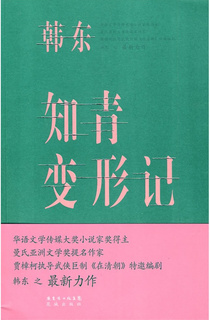
《知青变形记》Metamorphosis of an Educated Youth, 2010. Sample translation (not entire work) appears - accompanied by an introductory essay - under the title Screwed in Asian Cha literary magazine and also here, on Paper Republic.
Interviews/Blogs in English translation
On Chinese literature, contribution to PEN World Atlas, April 2012, available here
Voices in his head, interview for China Daily, April 2012, here
Poetry in English translation:
A selection of his poems in translation can be read here.Translated by Nicky Harman.
Another small selection, translated by Tony Prince and Tao Naikan, can be read here
And here translated by Nicky Harman
Han Dong's selected poems have been published in Capriccio on the Way to Buy Salt tr. George O'Connell and Diana Shi, Bridge21 Publications/Jiangsu Art and Lit, 2023.
Han Dong's selected poems have also been published in A Phone Call from Dalian by Zephyr Press, 2012. Multiple reviews include World Literature Today and Peony Moon
Guardian Poem of the Week, April 2012, can be downloaded here.
Other novels in Chinese: include Me and You 《我和你》, 2006; A Small Town Hero Strides Forth 《小城好汉-英特迈往》, 2008; and more...
Other work in Chinese: Poetry collection * Dad’s Looking Down On Me From The Sky 《爸爸在天上看我》 * Essay collection * Dynamics Of Love 《爱情力学》 * Short story collections * Our Bodies 《我们的身体》 * My Plato 《我的柏拉图》 * Bright Scars 《明亮的疤痕》 * In The Western Sky 《西天上》
About Han Dong:
Maghiel Van Crevel, Chinese Poetry in Times of Mind, Mayhem and Money, Brill (Netherlands), 2008, with two chapters devoted to Han Dong. Numerous other works on contemporary Chinese poetry discuss his work and influence.
Read Now: On Paper Republic
| One Night on the Wharf | tr. Nicky Harman | February 01, 2022 |
| View from a Window | tr. Nicky Harman | April 16, 2020 |
| Gu Jieming – a Life | tr. Nicky Harman | June 09, 2016 |
| The Bathtub – Scene of a Struggle | tr. Nicky Harman | May 12, 2016 |
| The Cry of the Deer | tr. Nicky Harman | January 21, 2016 |
Read Now: Around the Web
| The Cry of the Deer | tr. Nicky Harman | Pathlight: New Chinese Writing |
| The Wig | tr. Philip Hand | Granta |
Book Publications
Original Works
Poem (45)
- Yü (雨)
- Dongtian de Huangtang Jingse (冬天的荒唐景色)
- Tong (疼)
- Chengzhang de Cuowu (成长的错误)
- Rizi (日子)
- Wenrou de Bufen (温柔的部分)
- Mu Gong (木工)
- Xiatian Chuangkou (夏日窗口)
- Women Zuozai Jieshang (我们坐在街上)
- Zai Cizhuan Tiemian de Guangming Zhong (在瓷砖贴面的光明中)
- Yixie Ren Buai Shuohua (一些人不爱说话)
- Qi Wu le (起雾了)
- Zhexie Nian (这些年)
- yugang––wudou xianchangji (浴缸——武斗现场记)
- Lü Shu, Hong Guo (绿树、红果)
- Yidui Luanshi Zhong de Yige Ren (一堆乱石中的一个人)
- Yizhong Hei'an (一种黑暗)
- Wo Tingjian Beizi (我听见杯子)
- Yisheng Juxiang (一声巨响)
- Shandong Xing (山东行)
- Laizi Dalian de Dianhua (来自大连的电话)
- Yizhong Pingjing (一种平静)
- Yuan Yu (圆玉)
- Geligaoli Shengge (格里高里圣歌)
- Dianti Men ji Qita (电梯门及其它)
- Gongren de Shou (工人的手)
- Mai Ji de (卖鸡的)
- Youguan Da'eta (有关大雁塔)
- Shan Min (山民)
- Ni Jianguo Dahai (你见过大海)
- Jia Yi (甲乙)
- Ni de Shou (你的手)
- Huoche (火车 )
- Xie Zhechang Yü (写这场雨)
- Ji Shi (记事)
- Dui Hua (对话)
- Xiaoxi (消息)
- Duome Lengjing (多么冷静)
- Xiaojie (小姐)
- Ye Ban (夜航)
- Hengdu Lingding Yang (横渡伶仃洋)
- Zai Shenzhen de Ludeng Xia (在深圳的路灯下)
- Zai Shenzhen Zhi Yibang Pengyou (在深圳–致一帮朋友)
- Guilai (归来)
- Aiqing Shenghuo (爱情生活)
Short story (6)
Novella (1)
Novel (5)
Essay (1)
The Paper Republic database exists for reference purposes only. We are not the publisher of these works, are not responsible for their contents, and cannot provide digital or paper copies.