Our new Nobel laureate! As of October 11, 2012, Mo Yan is the first Chinese author living inside China without French citizenship and accepted by the Chinese government to win the Nobel prize for literature.
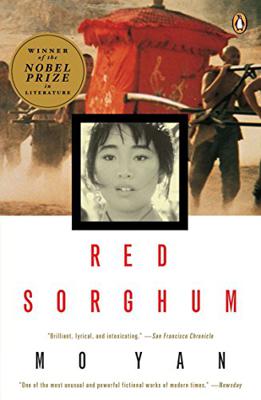
Mo Yan, more than any other Chinese author, is well represented in foreign languages around the world. And with good reason – he is one of the great novelistic masters of modern Chinese literature, with a long list of ambitious novels to his name. His writing is powerful, visual, and broad, dipping into history, fantasy and absurdity to tell stories of China and its people – many have seen the influence of Gabriel García Márquez in his writing. Originally counted a part of the "root-seeking" literary movement of the 80s, it quckly became clear that Mo Yan had a style and voice all his own. He is often regarded as the Chinese writer with the most potential to appeal to an international audience.
Winner of the Mao Dun Prize 2011 for 《蛙》"Frog".
Related:
Unless I'm very mistaken, which has been known to happen, the New Yorker's publication of "Bull", excerpted from Mo Yan's forthcoming novel POW! and translated by Howard Golblatt, marks their first foray into translated fiction from a mainland Chinese author. Publishing Mo Yan now may not quite be the bold move it would have been a few months ago, but still it's a landmark moment. Congratulations to Mo Yan, Howard Goldblatt, and the New Yorker!
Read a short interview with Howard on the NY-er blog.
By Eric Abrahamsen, November 20 '12, 7:48p.m.
Article: 'The (Bio)political Novel: Some Reflections on Frogs by Mo Yan', by Yinde Zhang, tr. by Jonathan Hall
Published in China perpectives [Online], 2012/4 | 2011, Online since 30 December 2014, connection on 14 October 2012. URL : http://chinaperspectives.revues.org/5748
More…
By Helen Wang, October 14 '12, 3:25a.m.
So they say the next Nobel prize for literature will be announced this week (Thursday?), and you would not believe the number of people writing around for Mo Yan's contact information.
Dear Western media: leave the poor man alone! He's busy writing the next Great Chinese Novel.
By Eric Abrahamsen, October 8 '12, 12:27a.m.
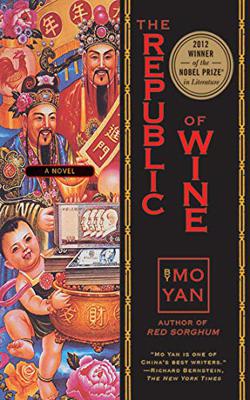
The Chinese writer Mo Yan has kindly agreed to answer questions by Oriental Hemisphere (Vostochnoye Polushariye), Russia's biggest website on the day-to-day life, history and culture of the Far East and South East Asia, in connection with forthcoming publication of Mo Yan's 酒国 (The Republic of Wine) translated into Russian by Igor Yegorov (aka yeguofu). English translation courtesy of Igor Yegorov.
Question: Has your recent visit to Russia left you with new impressions? Has your notion of the country changed, compared to that of the past?
Answer: I visited Russia for the first time in summer of 1996. It was a two-day tour in a small town next to the Chinese frontier city of Manzhouli. My impressions of that day fitted badly with the notion of Russia that I had formed while reading books by Russian authors. It was not until 2007 when I went to Moscow to take part in the Year of China Book Exhibition that I fully appreciated the space and grandeur of the country. The vast Russian expanses which seem to have no boundaries, conceal the boldness and a big way of the country combined with its delicacy and soft beauty.
Q: What do you feel about Russian literature and who is your favorite Russian author?
A: Russian literature was first of all foreign literatures that I got acquainted with. When still a child I read The Tale of the Fisherman and the Fish by Pushkin in my elder brother's school textbook, then I went through The Childhood (My Universities) by Gorky. Of course, like any Chinese youth of those times, I read How the Steel Was Tempered by Nikolai Ostrovsky. My favorite Russian author, Mikhail Sholokhov, and his novel Quiet Flows the Don have added a lot to my formation as a writer.
More…
By Eric Abrahamsen, February 24 '10, 2:04a.m.
The winner of the 2009 Dangdai Literary Prize was announced a couple of weeks ago (sorry, we've been eating dumplings in the northeast).
The shortlist included:
A Word is Worth a Thousand Words took the prize; Liu Zhenyun was also the winner of the 2007 prize with My Name is Liu Yuejin.
Previously…
By Eric Abrahamsen, February 18 '10, 8:20p.m.
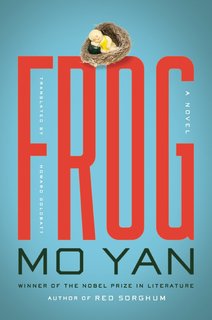
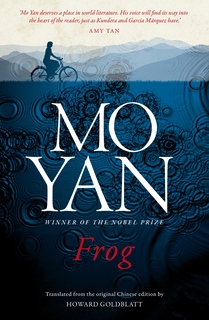
Mo Yan's newest novel, called Frog, is ill-served by its publicity billing: "A novel about the One Child Policy and population control!"
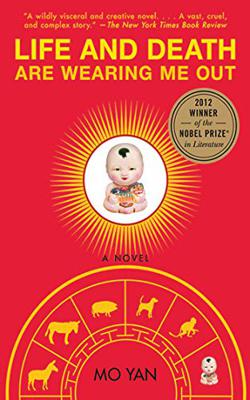
Unappealing as that sounds, Mo Yan is too accomplished a writer to simply dress up an historical tract as a novel, and Frog is in many ways a good read. The first thing I noticed was that he had abandoned the baroquely florid storytelling style of Life and Death are Wearing Me Out for a more traditional Chinese narrative, a descendent of the "gather 'round and I'll tell you a story" style more often associated with Su Tong. In this case, the book is narrated by a Communist Party member whose aunt – once known in their rural county as a miracle midwife – is one of the first implementers of the new planned-reproduction policies of the late 70s and early 80s.
The aunt is the heart of the story – her determination to carry out what she sees as a vital new policy, her demonization by rural families hell-bent on raising sons, her eventual reconsideration and regret. Mo Yan is still a master of the scene, of the dramatic moment, and there are many throughout the book: starving children discovering, with shuddering wonder, that coal is good to eat; the death of a pregnant woman who has plunged into a turbulent river rather than let the planned-reproduction team drag her back for a forced abortion; the same team demolishing the houses of neighbors of an anti-abortion holdout, in order to turn the whole community against the law-breakers.
More…
By Eric Abrahamsen, February 7 '10, 3:08a.m.
The Newman Prize for Chinese Literature is a new prize for Chinese writing sponsored by the University of Oklahoma's Institute for US-China Issues. Mo Yan has won the inaugural round, which you can read about here. From the home page:
The Newman Prize for Chinese Literature is awarded biennially in recognition of outstanding achievement in prose or poetry that best captures the human condition, and is conferred solely on the basis of literary merit. Any living author writing in Chinese (residing anywhere) is eligible. The Prize consists of $10,000 and a plaque, and may serve to crown a lifetime’s achievement or to direct attention to a developing body of work. An international jury of distinguished experts will both nominate the candidates and select the winner, based on a transparent voting process.
By Eric Abrahamsen, October 2 '08, 7:12a.m.
Mo Yan visited the Beijing Number Eleven School on Saturday, and spoke to students on the verge of taking the 高考 (gāokǎo, the test which determines a student’s chances of getting in college). There’s lots of hand-wringing (or at least there should be) about China’s high-school educational system, which steamrollers students into a single mold, and leaves them hardly any time to themselves in which they might repair the damage.
Mo Yan to the rescue. Never mind that the steamroller possesses the momentum of a celestial body; he encouraged students to do a little writing that “you don’t show your teachers” after graduation – keeping a diary or posting online. This sort of private writing would be essential in allowing them to form their own characters. He also said that students should be allowed to read what they pleased, and spoke positively about the ease with which young people could publish and read on the internet.
There’s something a little heartbreaking about Mo Yan speaking to these students, the scions of a nation which has given its people no peace for two generations, on the eve of one of the most grueling mass experiences many of them will ever undergo, and telling them, “try to make a little space for yourselves.” You can practically hear him add, under his breath, “you’re going to need it.”
By Eric Abrahamsen, March 10 '08, 9:04p.m.
A few days ago the Man Asian Literary Prize (aka the Asian Booker) announced the long list for its 2007 prize. Amid a large number of Indian candidates were a few familiar names: Mo Yan’s Life and Death are Wearing Me Out, Xu Xi’s manuscript Habit of a Foreign Sky, Guo Xiaolu’s 20 Fragments of a Ravenous Youth, and Jiang Rong’s Wolf Totem. Fleeting Light by Taiwanese writer Egoyan Zheng is also up there.
Five out of twenty-three: not a terrible showing for China, though clearly we’re not cranking them out like the Indians are (apparently two-thirds of submissions came from South Asia). It’s a happy day for Howard Goldblatt as well – the English versions of Wolf Totem and Life and Death are Wearing Me Out are both his handiwork.
The three-judge panel will select a five-book short list in October, and announce the winner November 10th in Hong Kong.
By Eric Abrahamsen, July 24 '07, 10:43p.m.