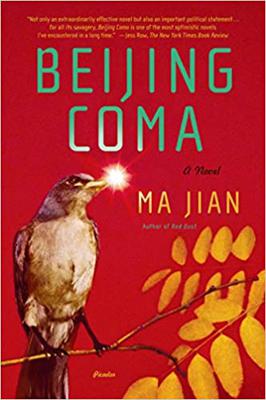
From Pankaj Mishra's review of Ma Jian's newest Beijing Coma, in The New Yorker:
A dissident writer’s pessimism, you suspect, can be as relentless and simplistic as a socialist realist’s optimism.
By Eric Abrahamsen, June 24, 2:37p.m.
I originally sent this as a comment on Eric's piece about Ma Jian's recent articles, but am now posting it with a few added comments:
On Tuesday 3 June, I attended an English PEN event in London entitled "Chinese whispers... are Chinese writers free to face up to the difficult issues facing their society in the twenty-first century, or are they forced to speak in a whisper?...” [this was one of several suggested topics, but basically the only one discussed in the short time available.] English PEN says it "campaigns to improve the understanding of freedom of expression as a fundamental human right" so you would expect the discussion to be focussed more on politics than on literature, as indeed it was. All the more important, then, that the debate should be balanced and well-informed.
The three Chinese speakers were Ma Jian, Liu Hong Cannon and Diane Wei Liang (the latter two write in English). I was disappointed, not to say frustrated, by the evening's event: it was dominated by a rant from Ma Jian, similar in tone and content to his 30 May Times article. I wrote down the following sentence (Ma Jian said it in Chinese, Flora Drew interpreted): Chinese writers can only do three things in China today - collaborate, remain silent or leave the country. This is a misleading and skewed statement in my judgment, and insulting to many writers in China. Why does it matter? Because Ma Jian is probably the most politicised and most vocal of diaspora Chinese writers. People do listen to what he says. Some of the audience came knowing very little of what life is really like in China - and went away knowing just as little, it seemed to me. (For example, towards the end, someone asked whether the three speakers were able to return to China. Diane and Liu Hong looked at each in some surprise, and said, yes, they go back every year. Even Ma Jian said that he could go back, just not publish there.) With the number and the quality of cultural events on China available this year in the UK, we should surely be able to leave the Cold War behind and talk about China as it really is, in all its complexity. A one-dimensional rant does nothing to increase understanding. (In fairness, please let me emphasise that Diane and Liu Hong expressed completed different views, when they could get a word in edgeways. Also, Ma Jian writes much better than he speaks - it is obviously more difficult to engage in debate where everything needs to be interpreted for you, no matter how good the interpreter.)
Can there ever be a well-informed debate about China when most of the participants are non-specialists? Well, take for example, the discussion which followed Jonathan Spence’s first Reith lecture this week on Confucius, on BBC Radio 4*. Index on Censorship, Amnesty and the church were all represented in the audience, and the basis of the lecture may have been historical, but the ensuing discussion focussed on contemporary moral and political issues. It did not matter that those who asked questions had clearly come prepared to say their piece, no matter how distant the link to Confucianism; the discussion was interesting on many levels, and one hopes it succeeded in opening up the debate about China in people's minds.
*Still available here as a podcast; a half-hour lecture was followed by half an hour of questions.
By Nicky Harman, June 7, 4:02p.m.
Ma Jian’s been doing quite a lot of speaking out recently; first there was his May 30th piece in The Times, condemning Chinese writers for their cowardice, and then this op-ed in the New York Times recently. Between the two of them I liked the New York Times piece better – it’s less shrill and better balanced, a realistic look at the state of Chinese society that is both furious and sorrowful. The bit from The Times, attacking writers, is a bit nasty:
Although officially they are government cadres, they refuse to admit their complicity with the repressive political system. One famous writer compares politics to a fly. “If its noisy buzz disturbs me, I can just shut the window and concentrate on my art.” When he travels to the West on book tours, he portrays himself as a dissident writer. He doesn’t realise that what he shut out was no mere fly. It was an entire landscape of morality.
…
There is little need for literary censors these days. The writers have learnt to do a proficient job of censoring themselves. Chinese fiction is in the main a fiction of compromise.
Reading something like this gives me an instant attack of the moral relativities. From a loftier moral standpoint than most of us can muster of a Tuesday morning, he’s absolutely right: China’s writers as a whole have failed the Chinese nation, and helped perpetuate the illusion that there is nothing deeply wrong with the country.
On the other hand, it’s unclear what, exactly, he’s asking of these writers. To push a little harder? Some writers are doing so, though not enough. To leave the country and lambast it from abroad? Several have taken this road; few of them have the slightest tangible impact on the advancement of freedom within China. To stand up and denounce the emperor for having no clothes? For a writer inside China to do that would mean self-immolation, and not the kind of bright funeral pyre that serves as a beacon for others, but the kind you find in the crematoriums, where the door seals tight and no one even notices the smoke. If Ma Jian had been inside China when he wrote those words, we would never have read them – it’s likely we would never have read anything he wrote, ever again.
More…
By Eric Abrahamsen, June 4, 6:34p.m.
It was originally Gordon Fairclough’s article in the online WSJ that got me thinking about road-trip literature in China, and now on top of that, wouldn’t you know, it happens to be the 50th anniversary of Kerouac’s On The Road. On The Road is one of a few discrete chunks of foreign literature (others include the works of Borges and Milan Kundera) that, for various reasons of historical accident, floated across the sea and became trendy here. There are readers who wouldn’t know Hemingway’s beard if it turned up in their soup, but by god they could point out Vesuvio Cafe on a SF street map.
Fairclough’s article mentions a growing road-trip literature in China, and cites “‘Go the Distance Now,’ a book chronicling five years spent traveling around China by car.” One travelogue does not a road-trip literature make, but it started me thinking – Kerouac’s popularity must point to some kind of latent interest in this sort of thing, and really, China is the perfect country for road literature. It’s obscenely large, for one. It sports unbelievable geographical and cultural diversity (anyone who believes in the homogeneity of the Chinese, including the Chinese themselves, needs to take a road trip). It’s traditional culture encourages stasis, and trepidation about venturing away from home. The place is ripe for some maverick to demonstrate the heady joys of having the wind in your hair. Actually, a fair number of younger, middle-class adventurers are discovering that for themselves, but as far as I know they have yet to find their bible.
So what have we got? Journey to the West aside, Ma Jian’s Red Dust is probably the closest thing there is to a road-side portrait of China. But it’s an awfully political book, and I wonder how many people actually read it inside the country. Xu Xing’s You Can Have Whatever’s Left, a picaresque about a couple of rogues wandering the country, definitely qualifies. I suppose even Gao Xingjian’s Soul Mountain counts, although that struck me less as road literature and more as one man’s tiresome journey through his own angst-ridden impotence (ahem).
How about it? What am I missing?
By Eric Abrahamsen, September 7, 8:26p.m.